What does AI Native mean?#
For a long time, an engineering organisation's capacity was limited largely by how much work its people could produce. Cloud native changed the economics of delivering software: teams could deploy more often, learn from production and improve their systems without treating every release as a major event. AI changes another part of the equation. Code, analysis and other work can now be produced much faster, sometimes in parallel. The time needed to decide what to build and verify that it works does not fall at the same rate.
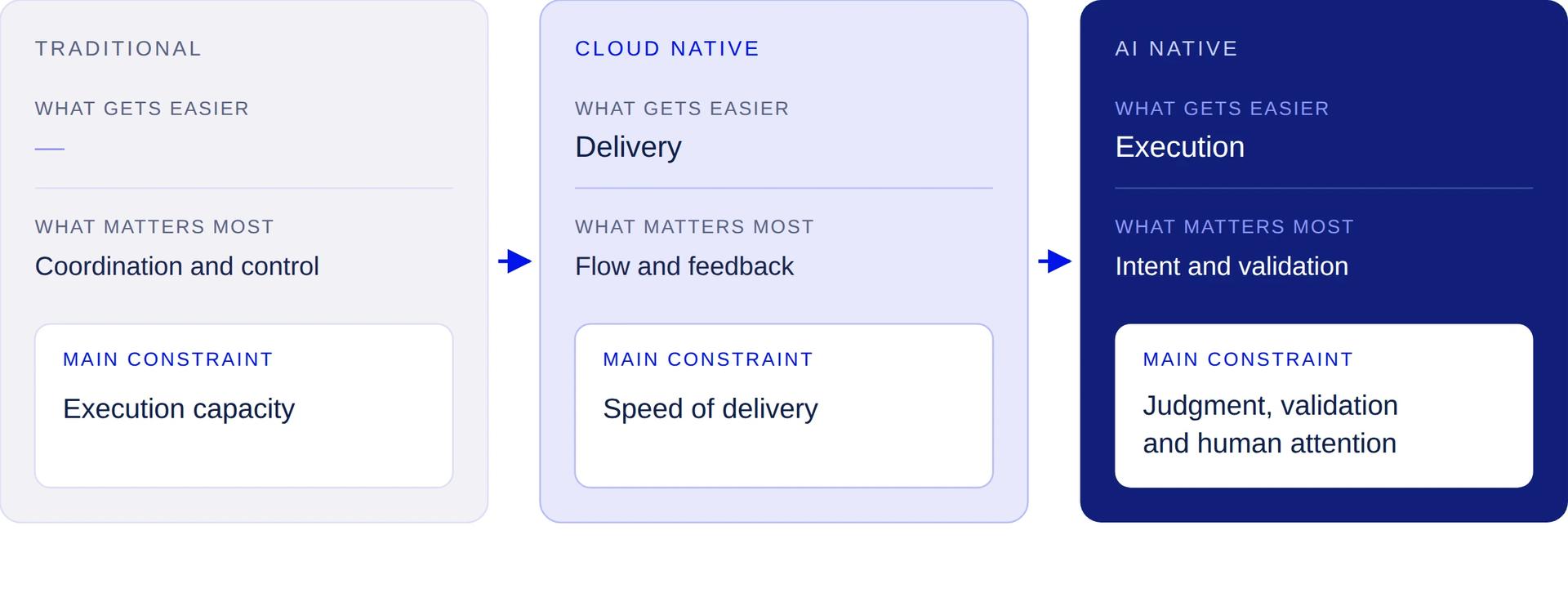
There is no agreed definition of AI Native. Gartner's 2026 trends list uses AI-native development platforms for tools that use generative AI to build software. IBM uses AI Native products for products designed with AI at their core. At re:cinq, we generally use the term for organisations: teams that have changed how work is planned, delegated, reviewed and governed to account for what machines can now do.
There is a familiar pattern from Cloud Native. Many organisations adopted containers long before they changed the release processes and team responsibilities around them. AI tools are being adopted in much the same way: a developer gets faster at producing code, while the route from an idea to production remains largely as it was. Our book, From Cloud Native to AI Native, covers the wider transition. This article focuses on the changes that would make the term AI Native meaningful for an organisation.
What is the difference between AI Native and AI enabled?#
In an AI enabled organisation, people use AI within the processes they already have. An engineer might finish a change sooner, only for it to wait in the same review queue. A specification might take an afternoon instead of a week, yet still pass through the same set of approvals. Individual productivity improves, but delivery does not necessarily follow.
In an AI Native organisation, teams have also changed the surrounding workflow. They decide which steps require human judgment, where automated checks are sufficient and whether existing handoffs still make sense. People remain responsible for consequential decisions, but their attention is directed towards decisions that need it.
IBM suggests testing a product by imagining it without AI: would it lose a feature, or would it cease to work as intended? Applied to an engineering organisation, the question is whether removing machine execution would merely slow the team down or force it to change how work is organised.
| AI enabled | AI Native | |
|---|---|---|
| What changed | Individual tasks got faster | Work is defined, delegated and checked differently |
| Where AI sits | Inside existing steps | In the design of the workflow |
| Where time is lost | Often the same old queues | New limits emerge around judgment and validation |
| Evidence to look for | Individual productivity reports | Changes in delivery outcomes |
| If AI is removed | Throughput falls | The operating model has to change |
Why does buying AI tools not make an organisation AI Native?#
The gains from AI tools are real, but they can disappear into the rest of a delivery process. In a field experiment involving nearly 5,000 developers, developers with an AI assistant completed about 26% more tasks, with the largest gains among those with less experience. If completed changes then wait for review, approval or release, the organisation may see little benefit from the extra output. We call the practice of adding tools while leaving that process intact tooling substitution.
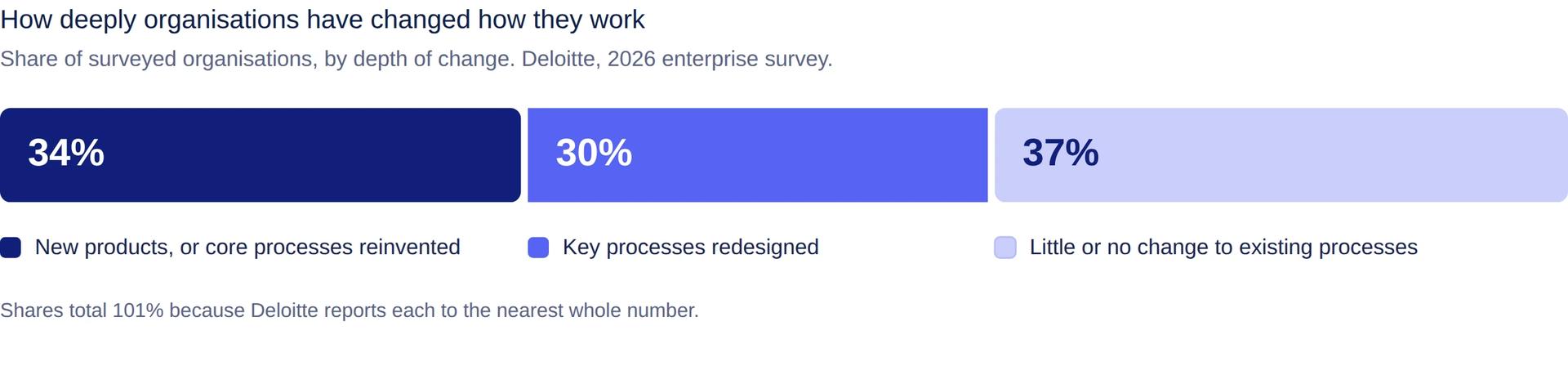
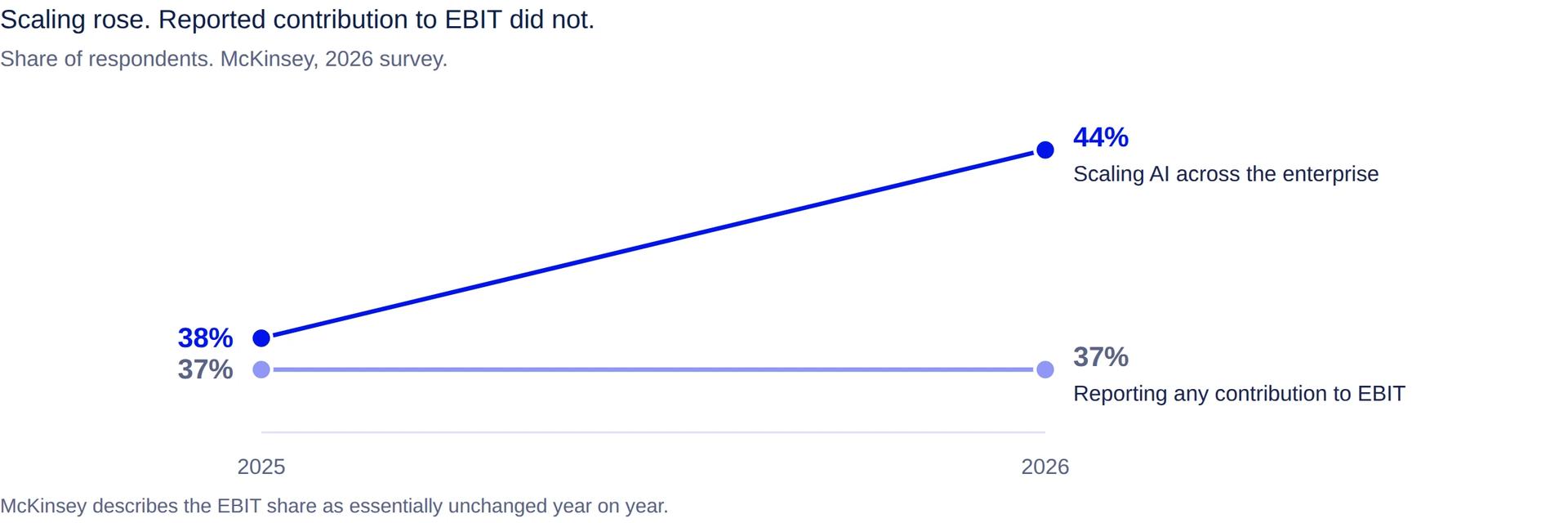
That gap shows up in survey data. Deloitte's 2026 enterprise survey found that 34% of organisations were using AI to create new products or reinvent core processes, 30% were redesigning key processes, and 37% were using it with little or no change to existing processes. In McKinsey's 2026 survey, the share scaling AI across the enterprise rose from 38% to 44%, while the share reporting any contribution to EBIT remained around 37%. These surveys cannot tell us why any one company's results have stalled, but they do give us reason to look beyond how many people have access to a tool.
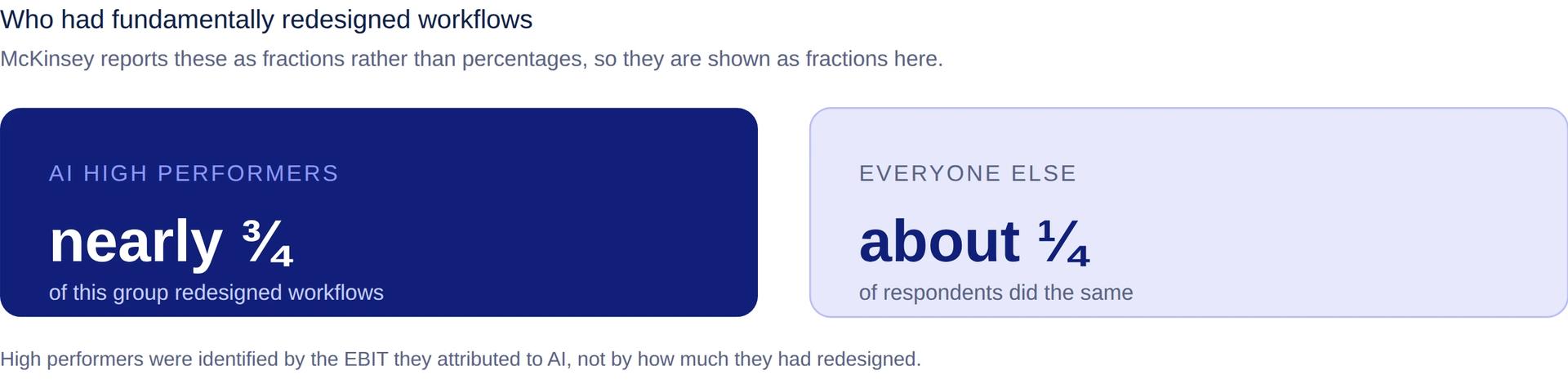
McKinsey also found that nearly three quarters of its AI high performers had fundamentally redesigned workflows, compared with roughly a quarter of other respondents. Because the high performers were identified by the EBIT they attributed to AI, the finding is not simply a result of how the group was defined. It still does not establish that workflow redesign alone caused the difference, but it is a stronger signal than tool adoption figures on their own.
What changes in an AI Native organisation?#
Much of the work starts with deciding what a machine may do without a person reviewing every step. A small change covered by reliable automated checks is different from an architectural decision, a security exception or a customer-facing judgment call. Teams need to set those boundaries explicitly and revisit them as their systems and models change.
That puts more pressure on validation. Reviewing every change by reading it may be workable when a team produces a manageable number each week. It becomes harder when agents can produce many plausible changes in parallel. Tests, policy checks and other automated gates need to cover the things they can reliably judge, leaving people to examine the cases that require context. Our work on the AI Native operating model goes further into how that division of responsibility works.
As agents take on more execution, a hybrid team needs clear responsibilities on both sides. Someone must own the outcome, know when an agent should stop, and decide what happens when a check fails. Managers also need to preserve the expertise of the people assessing the work. A reviewer who has lost touch with the system will struggle to catch an answer that looks convincing but is wrong.
What does AI Native change about engineering roles?#
An engineer's title may stay the same, even as the work inside the role changes. Writing code remains part of it, but deciding what should be built, giving an agent enough context to act and checking whether it met the requirement take up more time. Experienced engineers have always done this work. AI makes the quality of those decisions more visible because the machine can produce a great deal of output from a poorly framed request.
This is one reason spec-driven development matters. A colleague may ask a follow-up question when a requirement is vague; an agent may make an assumption and continue. Teams need to state the intent, constraints and conditions for a successful result clearly enough for the work to be checked. Organisations that already write down decisions and requirements have a better starting point than those where most of that context lives in conversation.
Reviewing machine-produced work can also take more effort than reviewing a colleague's pull request. With a colleague, a reviewer can ask what they tried and why they chose a particular approach. An agent's output may leave the reviewer to reconstruct those choices. Unless the team improves its checks and the context supplied with each change, faster production simply means a longer review queue.
Senior engineers are central to this. They know which trade-offs a system can tolerate, where a plausible change can introduce a subtle failure and what "correct" means beyond passing the tests. Those decisions take time and experience, and the volume of machine output can make them more demanding.
How does Cloud Native maturity relate to becoming AI Native?#
An organisation with mature Cloud Native infrastructure already has some of the machinery needed to deploy and operate AI workloads. The CNCF's annual survey, fielded in September 2025, found that 82% of container users run Kubernetes in production. Among organisations hosting generative AI models, about two thirds use Kubernetes for some or all inference workloads. That experience can shorten the platform work involved in the transition.
It does not settle the question of whether teams will make good use of AI. The CNCF's August 2026 guidance points out that a platform ready for containers is not automatically ready for AI, and we are not aware of evidence that Cloud Native maturity by itself predicts better AI outcomes.
The organisational experience may be more valuable than the infrastructure. In the same CNCF survey, 47% cited cultural change within development teams as the leading obstacle to Cloud Native adoption. Years of platform investment did not remove the need to change responsibilities and habits. AI is bringing similar questions into approvals, ownership, review and leadership. Teams that learned to look at delivery outcomes rather than the tools they had installed can apply the same discipline here.
What does an AI Native system look like in practice?#
At the system level, AI Native usually means software whose core behaviour depends on models. Adding a model call to one part of a conventional application does not necessarily change the character of the whole system.
Depending on the application, the system may need separate ways to prepare data, train or adapt models, and serve inference reliably in production. These parts scale differently and fail in different ways. If they are bound together as one deployable unit, making a change safely can become difficult. Cloud native teams will recognise the need to separate responsibilities, though model artefacts and inference bring engineering questions of their own. Our AI platform reference architecture covers the design in more detail.
It is possible to build a well-designed AI Native system inside an organisation that still approves every change at a weekly meeting. The architecture of the product and the way the organisation operates have to be assessed separately.
How can you tell whether an organisation is AI Native?#
To assess an organisation, follow a piece of machine-produced work from the initial request through review and release. Who set the boundaries for the agent, what checks ran, and where did the work wait? The answers tend to tell you more than a list of tools in use.
| Question | Common AI enabled answer | What an AI Native answer looks like |
|---|---|---|
| Who decides what a machine may do without review? | It varies by team or has not been written down | The delegation boundary is explicit and revisited |
| How is machine-produced work checked? | Through the old review process | Automated gates handle what they can; people handle the rest |
| What happens between stages? | The change waits in the same queues | Handoffs and waiting have been reconsidered |
| Where do experienced people spend time? | Primarily on execution | On intent, validation and judgment |
| What happens if model access disappears? | Throughput drops | The operating model has to change |
If the organisation can describe its licences and models in detail but cannot explain what changed in review, approvals or ownership, it is probably still early in the transition.
How do organisations become AI Native?#
Begin with work a team already needs to deliver. A demonstration built around an isolated prompt may show what a model can produce, but it rarely tells you what happens when that output reaches a real codebase, a reviewer and a release process. Early experiments should expose where time goes: defining the work, producing the change, checking it, getting approval, deploying it and learning whether it helped. A delivery outcome also gives people outside engineering something concrete to evaluate.
Once the team understands the bottleneck, it can redesign a workflow around it. Faster code generation cannot remove an approval queue that remains mandatory. Changing that queue may mean agreeing who can approve which classes of change, how requirements are specified and which checks need to pass before a person is involved. These discussions can be difficult because they concern responsibility and risk across teams.
Broader delegation depends on having enough validation capacity. If agents produce more changes than the organisation can check, a successful pilot will turn into a larger review problem. Automated gates and clear rules for escalation should be established before the volume rises. The AI Adoption Ladder describes this progression from exploration through workflow redesign and validation to adoption across teams.
Engineers can establish good practices in individual teams, but they cannot usually change approval structures, responsibilities and investment priorities on their own. That requires leadership to participate in the work. Our AI Native assessment examines where the organisation is in this progression and identifies the constraints that need attention next.
What gets in the way of becoming AI Native?#
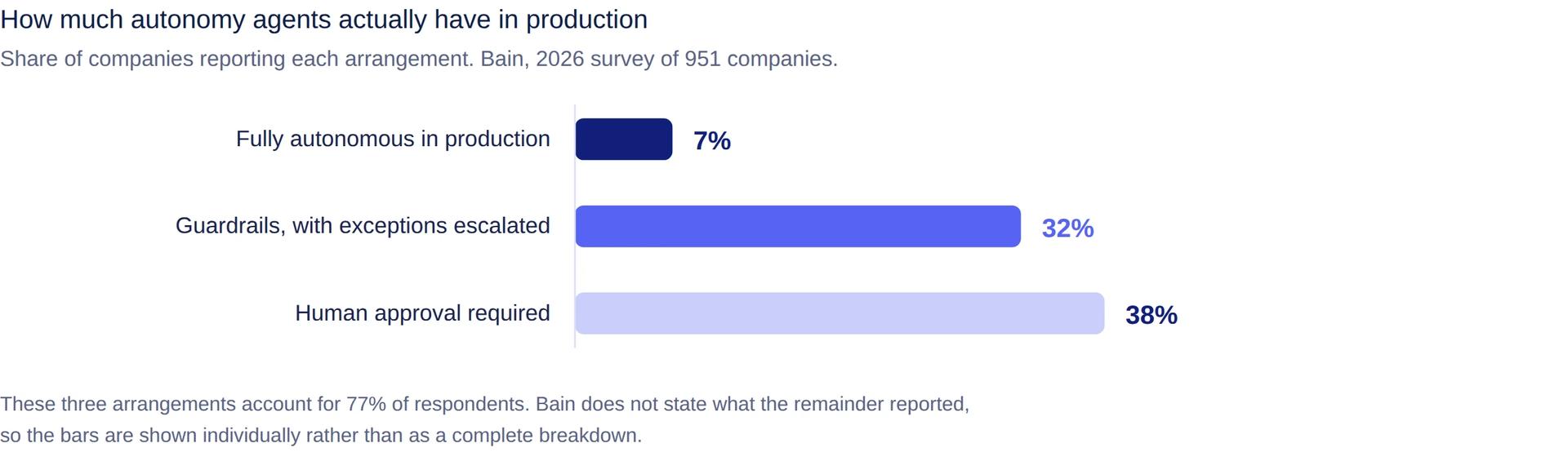
One obstacle is planning around a level of autonomy that the organisation cannot yet support. In Bain's 2026 survey of 951 companies, 7% reported fully autonomous agents in production. Another 38% required human approval, and 32% used guardrails with exceptions. The degree of autonomy a team can use depends as much on its checks and processes as on the model it chooses.
Review is another limit. Stack Overflow's 2025 developer survey found 84% of developers using or planning to use AI tools, while only about a third trusted the accuracy of their output. Some 66% cited results that are "almost right, but not quite" as a leading frustration. A plausible mistake can take more effort to find than an obvious failure, particularly when reviewers have many changes to process.
There is also a longer-term question about expertise. People become good reviewers by working with the code, the system and the decisions behind it. If they stop engaging with those details, they may gradually lose the context that lets them spot an error. Teams need to consider how engineers will continue to build and maintain that understanding even when an agent produces the first draft.
The evidence used to justify decisions needs scrutiny too. The frequently repeated claim that 95% of AI pilots fail comes from a preliminary working paper whose own funnel describes roughly a quarter of pilots succeeding. Before using a figure like that to set a strategy, it is worth reading what the source counted as a pilot and what it counted as success.
Governance often trails deployment. Deloitte reported that only around a fifth of organisations had a mature governance model for agentic AI, despite much broader plans to use agents. In the absence of shared rules, individual teams will decide what to delegate and what to review in different ways. Those choices are already shaping the organisation's risk, whether or not anyone has written them down.