Towards an AI Native Operating Model
An AI native operating model is the system by which an organisation turns intent into outcomes using people and machines together. Part 1 of 7.

 9 mins read
 21 Sept 2026
AI Native Operating Model · Part 1 of 7
When a technology changes the economics of work, the organisation has to change with it. This is the first of seven posts on what that means in practice.
Cloud native started with technology: cloud infrastructure, containers, infrastructure as code, automated testing, CI/CD. The change then spread outward. Engineering moved to small batches and continuous delivery. Product had to become iterative, because releases no longer came twice a year. Customer feedback had to arrive in days. Planning and funding had to move from annual projects to long-lived products. Architecture had to support constant change. Team structures were redesigned around flow and ownership.
Companies that bought the tools and kept their old structure got a fraction of the benefit. The ones that changed how they were organised got the rest.
AI is the same kind of shift, and probably a bigger one. A company that keeps the same structure, the same processes and the same management habits, and adds AI tools on top, will get faster local work and very little else. The most common failure we see is exactly that: buying the artefacts of change, a portal, a pipeline, a set of assistants, instead of changing how work flows. Automation amplifies whatever system it lands in. Where intent is clear and results are checked, it speeds things up. Where they are not, it produces unchecked work faster, which is worse than slow.
A small example of a big problem
A coding agent finishes in twenty minutes what used to take a developer two days. The pull request then waits four days for a first review, because the reviewer already has nine others. Security looks at it the following week. It ships a month later, behind an integration that three parallel branches all touched. The agent did what it was asked to do, and everything around it stayed as it was.
We see the same shape in our value-stream assessments. A change that holds two or three days of engineering work routinely takes five or six months from idea to production. Most of that time is waiting between stages: for priorities, for approvals, for other teams, for decisions. Compressing three days of work into an afternoon removes about two days from more than a hundred and fifty. The rest is the operating model.
What an operating model covers
By operating model we mean how a company turns ideas into real value. That covers:
- Technology: platforms, agents, the software factory, the data and context they run on
- Process: how work flows from an idea to a customer
- Value flow: where work waits and what it is waiting for
- Team structure: who owns what, and how teams are shaped
- Organisation design: decision rights, governance and risk
- Leadership and management: what managers do, and how people develop
AI touches all of them. Writing code with an LLM is one small part.
Our working definition: an AI native operating model is the system by which an organisation turns intent into outcomes using people and machines together, while it keeps deciding where machines act on their own, where people judge, and how both stay informed, safe and able to learn.
This series explores it in seven posts. It is a hypothesis we are testing, and it is not finished.
Every operating model is built around a scarcity
A useful way to read any operating model is to ask which scarcity it was built to manage.
Traditional management grew up when execution was expensive and coordination was hard. Hierarchy, functional departments, annual plans, project management and approval chains are all answers to that. It optimised coordination and control.
Agile and cloud native made delivery cheap and frequent. The answers moved to flow and feedback: small batches, autonomous teams, product ownership, fast loops.
AI native makes execution itself cheaper, faster, more parallel and less tied to headcount. Machines can research, write, analyse, design, test and run workflows. What becomes scarce is everything around execution: intent, prioritisation, comprehension, judgment, validation, trust, attention, and the organisation's ability to absorb change.
Traditional management optimised coordination. Cloud native optimised flow and feedback. AI native management has to optimise the boundary between what machines do and what people decide.
The older problems do not go away. Coordination and flow still matter. This one is added on top.
The loop
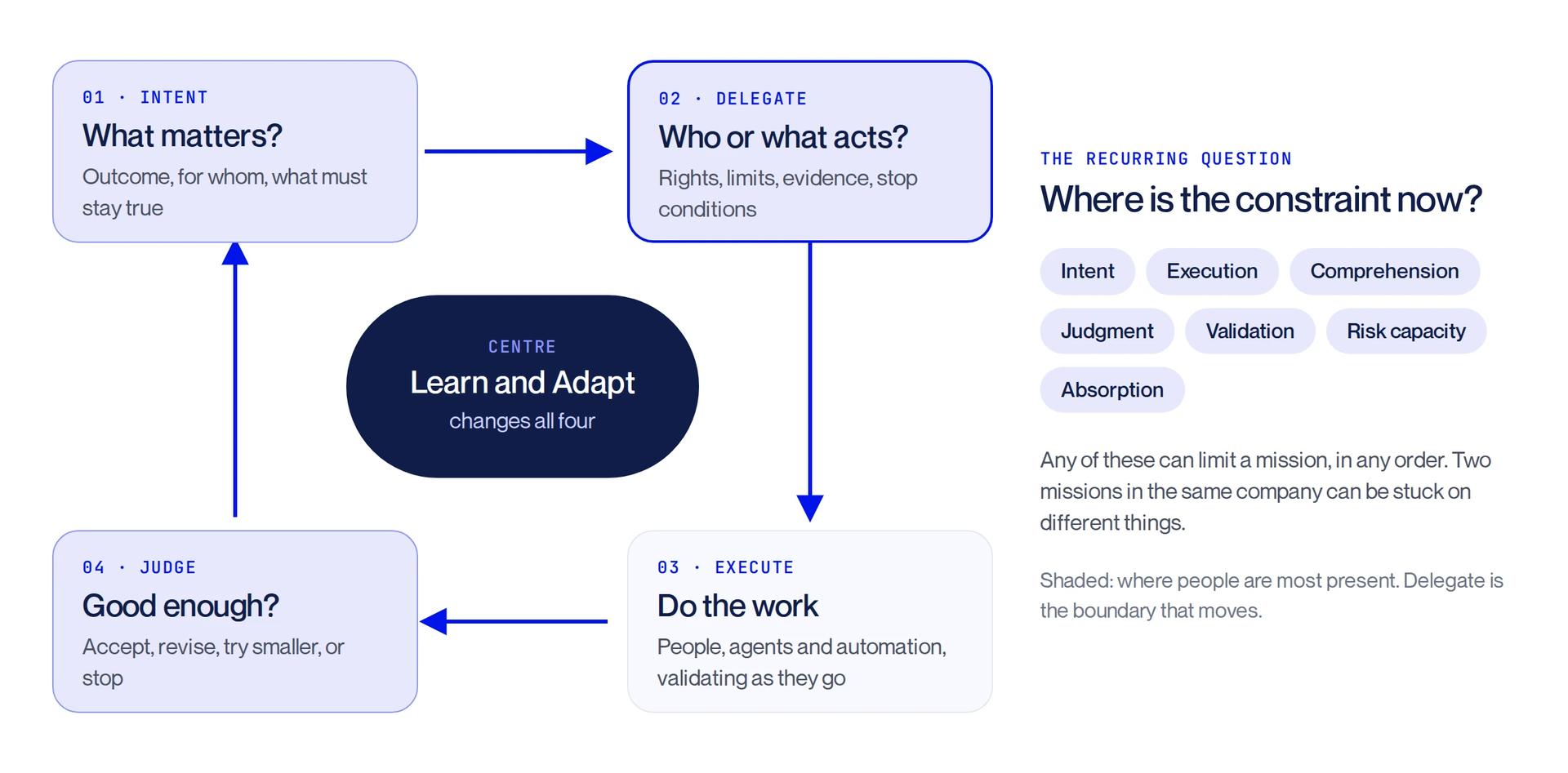 The operating loop: Intent, Delegate, Execute and Judge, with Learn and Adapt at the centre.
The model has four activities and a centre.
Intent: what matters? The outcome, for whom, the priorities and what must stay true. A team improving customer onboarding starts with customers reaching something useful sooner. It does not start with a feature count.
Delegate: who or what should act? Which parts machines may do, with which permissions, within which limits, with what evidence, and where they must stop and ask. Being able to do something does not give an agent the authority to do it. This activity did not need a name before, and most of the new design work sits here.
Execute: do the work. Agents, factories, workflows, platforms and people, each where they fit. People do whatever sits outside current machine capability or outside the delegation boundary.
Judge: is it good enough, and what happens next? Validation, evidence, exceptions, trade-offs and acceptance. Accept, revise, try something smaller, or stop.
Learn and Adapt sits in the centre, because it changes all four. Why did a person have to step in? Was it a real judgment, or was something missing in the system? Should a permission widen, or narrow? Has the constraint moved?
These are activities that repeat. Nobody needs four new departments, and the loop does not mean a human approval after every machine action.
If you know Boyd's OODA loop (observe, orient, decide, act), the same logic applies. AI does not remove the loop. It makes the act part much faster, which moves the load onto orienting, deciding and handling exceptions. The design goal becomes: increase useful autonomous throughput without pushing human cognitive load past what people can sustain.
Three loops, nested
The same loop runs at three levels, and it helps to name them.
The enterprise loop: sensing the market, setting strategy, choosing opportunities, allocating capacity to missions, and learning from outcomes. It answers why we are doing this, and where the organisation's capacity should go.
The delivery loop: from an idea to a measured outcome. An idea is validated cheaply before it takes delivery capacity, built, released under controls that match its risk, and measured. The measurement decides what happens next. This loop spans product, engineering, operations and often finance and legal. It is where most of the value is, and where most of the waiting is.
The build loop: from a specification to a merged, tested change. This is where the AI software factory does most of its work today, and it is the best tooled of the three.
The factory executes. The operating model decides what gets executed, by whom or what, under what authority, at what risk, with what evidence, and where a person must judge. A common pattern is heavy investment in the build loop while the constraint sits in the delivery loop. You can see it in the numbers: a large gap between active work and elapsed time.
Software is the first laboratory, because the change is easiest to see there. The work is digital, feedback is fast and the instrumentation exists. The same pattern is likely to reach marketing, finance, operations, support, legal and product work. We have not tested that yet. The model is built so it can.
Where is the constraint now?
The evidence that AI speeds up local work is real. Across three randomised field experiments with 4,867 developers, Cui and colleagues estimated about 26% more completed tasks with an AI coding assistant, with wide uncertainty between the experiments.1 That says nothing yet about lead time or customer outcomes.
Throughput is set by the constraint. Speed up anything else and you mostly get more work waiting in front of it. AI adoption is better understood as constraint migration than as automation.
A pattern we often see goes like this. First the machine cannot act usefully because it lacks context. Fix that and output rises, so validation becomes the limit. Improve validation and people cannot keep up with what is being produced, so comprehension becomes the limit. Then consequential judgment. Then the deeper question of what is worth doing at all. Eventually an organisation may produce change faster than its customers, staff or regulators can absorb.
Treat it as a pattern to look for. The order is not fixed. Unclear intent can hold a mission back from day one. Execution can still be the limit. Two missions in the same company can be stuck on different things. So the operating model comes down to one question, asked again and again: where is this mission being held back right now?
Why judgment gets harder
AI does not simply reduce human work. It changes the conditions in which people judge.
- Volume. Machines produce far more than people can review by hand.
- Compression. Days of thinking happen in minutes. You see the result without having lived through the process.
- Distance. People who do less of the work gradually lose their feel for how the system behaves.
- Complexity. Some output is too large or changes too fast to inspect line by line.
- Correlated failure. Agents that share a model, context and tools can share the same blind spots.
Two decisions stay with people for good: what is worth building, and whether to accept the risk of releasing it. Those are Intent and Judge. Automate the first and you build the wrong thing efficiently. Automate the second and nobody is accountable when it goes wrong. Many checks in between can become automatic once their signal is trusted, though judgment still comes up mid-mission, in exceptions and trade-offs.
The useful question, then, is less about where to insert a human and more about how to make the right person decision-ready at the right moment: a clear decision, the right expertise, enough understanding, the evidence to hand, and time to act. A human gate where the person cannot really judge is not a safety mechanism.
This also moves where people look. The old habit was to inspect the implementation to work out whether the system was good. Increasingly, people will define what good means and inspect the evidence that the system meets it. Architecture follows the same path. If generated code is cheap to rebuild, architects will spend more time on what must remain true: data boundaries, security properties, recoverability, cost limits, invariants. Structure still matters wherever validation cannot capture the consequences.
What changes in the organisation
The next six posts each take one part of the organisation.
- Team structure. Hybrid teams: stable human ownership, with machine capacity that changes with the work.
- Governance. The delegation boundary: what machines may do, which decisions stay with people, and how that line moves.
- Visibility. The Control Room: a map of the enterprise that shows where judgment is needed.
- Interfaces. Handoffs between people and machines, designed like APIs.
- Management and leadership. Leading missions, developing people, improving the system.
- Process and improvement. Flow, measurement, and moving the constraint on purpose.
Two disciplines run through all of them. Context Engineering prepares what machines need to act. Comprehension Engineering prepares what people need to decide. The second has its own four-post series.
Machines execute, and accountability stays with people and with the company. That part does not move.
We are trying to follow our own advice in how we write this. The model has one simple picture at the top. Each part opens into its own simple picture when you need it. A giant methodology poster with sixty boxes would break the principle it is meant to describe.
Where to start
Pick one mission. Follow it from intent to outcome. Write down what machines may do, which decisions stay with people, and where the work actually waits.
For each wait, ask what it is waiting for: evidence, authority, attention, or a choice that really needs time. Then ask which of those your current structure, processes and management habits create. Fix the one that holds the most back, then look again.
If you are running any of this for real, we would rather hear a counterexample than agreement. Tell us where your constraint actually moved, what you tried that did not work, and which decisions you found you could not delegate.
The next post looks at the unit that owns the work: the hybrid team.
Next in the series: The Hybrid Team.
Where did your constraint actually move? We run value-stream assessments that find the real bottleneck in hybrid delivery, then help design the operating model around it. info@re-cinq.com
Your next read

Don't Blame the AI: The Real Reason 95% of GenAI Pilots Are 'Failing'
Why the headline about 95% of GenAI pilots 'failing' is misleading and what organizations should fix instead.
Michael Mueller20 mins read

Subscribe to Our Bi-Weekly AI Native Newsletter
Lessons from our client work, engineering deep-dives, and the AI Native research worth reading.
Bi-weekly. No spam, unsubscribe anytime.

 7mins
7mins