Waves of Innovation Is Now Rethink Engineering
Discover why Waves of Innovation became Rethink Engineering, meet new host Bene and see what's coming next.

 6 mins read
 25 Sept 2026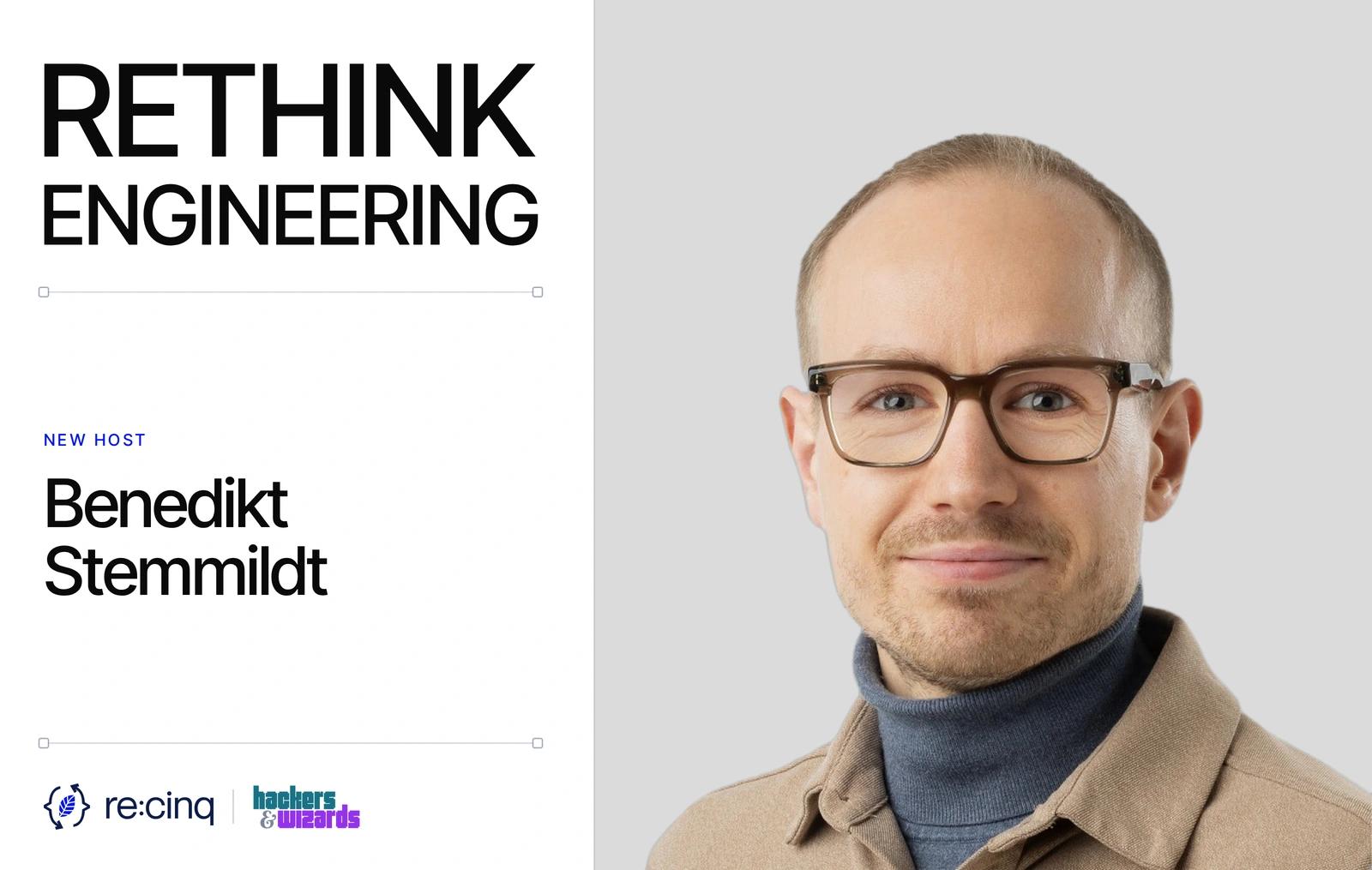
The podcast you know as Waves of Innovation is now called Rethink Engineering. We also have a new host, and we are producing the show together with hackers&wizards. The feed has not changed, we are still publishing monthly, and all 17 previous episodes remain available. Here is what has changed, and why.
Why the name changed
Waves of Innovation grew out of re:cinq's own journey from Cloud Native to AI Native. It was a good fit for the first 17 episodes because it reflected where we had come from.
Over time, though, the conversations developed a much clearer focus. Recent episodes have kept returning to the same question from different angles: what needs to change in the way engineering teams work now that AI agents can write a significant share of the code? This is not simply a conversation about which tools companies should buy. It is about how engineering organisations are structured, managed and measured.
Our new host, Benedikt Stemmildt, described it well in his first episode. The show is about how we "rethink how we currently do engineering, how teams work, how organisations organise themselves." That is a much broader conversation than any single tool, and Rethink Engineering better reflects what the podcast has become.
If you already subscribed to Waves of Innovation, there is nothing you need to do. It is still the same feed, and every previous episode will remain available.
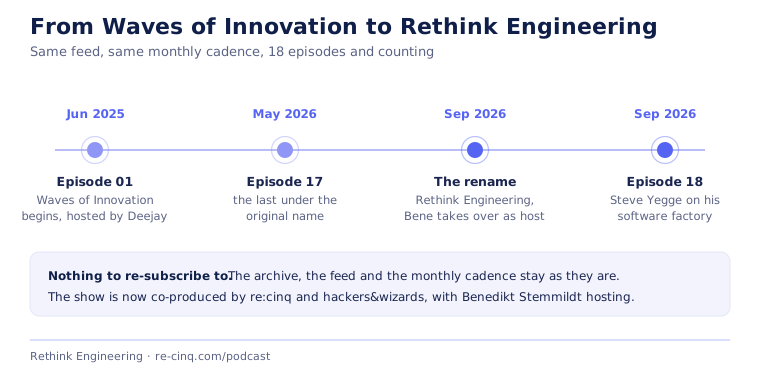
Figure 1. What changed, and when. The feed and the archive stay where they are.
A new host: Benedikt Stemmildt
Deejay hosted the podcast from its first episode with Pini Reznik in June 2025 through to episode 17. He is now leaving re:cinq to join AND Digital, and we are grateful for everything he put into building the show. Thank you, Deejay, from all of us.
Our new host is Benedikt Stemmildt, or Bene, as most people know him. Long-time listeners may already recognise him from episode 13, where he joined us to discuss the skills gap in agentic coding training.
Bene has spent around twenty years working in software, largely inside the engineering organisations themselves. He has worked as a software engineer at OTTO, lead software architect at Breuninger, CIO at BLUME 2000 and CTO at TalentFormation. In 2024, he founded hackers&wizards, which provides agentic engineering training, assessments and software factory pilots. He is based in Hamburg, chairs code.talks, curates CASE Berlin and has taught with Hacker School since 2014. His book, Building the Software Factory, written with Alex Merced, is due to be published by Packt in November.
What makes Bene particularly well suited to the podcast is that he has led engineering organisations through periods of change. That is the situation many of our listeners are dealing with now, and it gives him a practical perspective on the conversations we want to have.
Co-produced with hackers&wizards
Rethink Engineering is now powered by re:cinq and hackers&wizards. Our companies already work together on client projects, so extending that partnership to the podcast made sense. re:cinq will continue to produce the show, Bene will host it, and both teams will introduce guests through the work and communities they are involved in.
This gives us access to a broader group of people with first-hand experience, and helps us keep the podcast focused on useful conversations rather than on either company.
The newest episode: Steve Yegge on burning down his own software factory
Episode 18 is available now. Our guest is Steve Yegge, the creator of Gas Town and Beads and the author of some of the most widely read essays in this field. He currently runs around 50 coding agents against Wyvern, a game codebase he first started in 1995.
A week before we recorded, Steve removed roughly 40% of his software factory. Over time, his agents had added more than a hundred safety gates, eventually creating so many restrictions that very little could move. A newer model reduced those gates to 14. Once the unnecessary controls were gone, the fleet shipped 46 features during a week Steve had officially declared a feature freeze.
We discuss how he manages a merge queue handling 230 commits a day, why he spends around 40% of his effort on code quality, and one of his more important arguments for enterprise leaders: AI may enter large organisations through production ticket queues before it reaches the software development lifecycle. That is the reverse of how many companies are currently planning their adoption.
The episode runs for 1 hour and 10 minutes. The episode page also includes the full transcript, chapters and key highlights. Listen to the episode.
Who is coming up
We already have two guests booked whom we are especially looking forward to speaking with:
- Sam Newman, author of Building Microservices, will discuss what development at agent speed means for architecture and for the boundaries within which teams work.
- Patrick Debois, who coined the term DevOps and started devopsdays, will look at what this shift has in common with the DevOps movement, as well as where that comparison stops being useful.
There are more guests in the diary. If there is someone you would like us to invite, or if you are doing interesting work in this area and would like to join us, please get in touch. Bene mentions this at the end of every episode because we genuinely want to hear from the people doing the work.
The practicalities
- Where to listen. The podcast is available on Spotify, Apple Podcasts, YouTube and Amazon Music. Some platforms may continue to show the old Waves of Innovation name while the update works its way through, but it is still the same show.
- Episode pages. Every episode at re-cinq.com/podcast includes a full transcript, timestamped chapters, highlights and information about the guest. The transcript also makes it easy to search an episode when you are looking for a particular part of the conversation.
- Cadence. We publish one episode each month.
- Format. Most episodes are conversations of around an hour with people who are actively doing this work. When it is useful, we also include screen shares and live demonstrations. In episode 18, for example, Steve walks Bene through his agent control room.
- Get in touch. You can send guest suggestions or ask to join the podcast by contacting any of us directly or by using the contact form on our website.
The first 17 episodes are all still available. Several are especially relevant to the direction of the renamed show, including Mike Gehard on software factories, Amy Heineike on evals, Lauren Peate on measuring AI's effect on teams, Jaime Jorge on code review when AI writes the software, and our two conversations with Odevo about moving an engineering organisation towards agentic coding — with Tomasz Maj and with Dominic Warchalowski.
The name has changed, but the aim is the same: honest conversations with people working through how software engineering is changing.
Your next read
AI Native DevCon: We're Sponsoring!
re:cinq sponsors AI Native DevCon on June 1 at The Brewery in London. Odevo's transformation, a Pini Reznik book signing, demos, and a raffle.
Yonatan Reznik2 mins read
Subscribe to Our Bi-Weekly AI Native Newsletter
Lessons from our client work, engineering deep-dives, and the AI Native research worth reading.
Bi-weekly. No spam, unsubscribe anytime.
 3mins
3mins