


00:00
The Banker Who Built An AI Factory
ai chatbots
prompt engineering
banker to coder
ai hallucinations
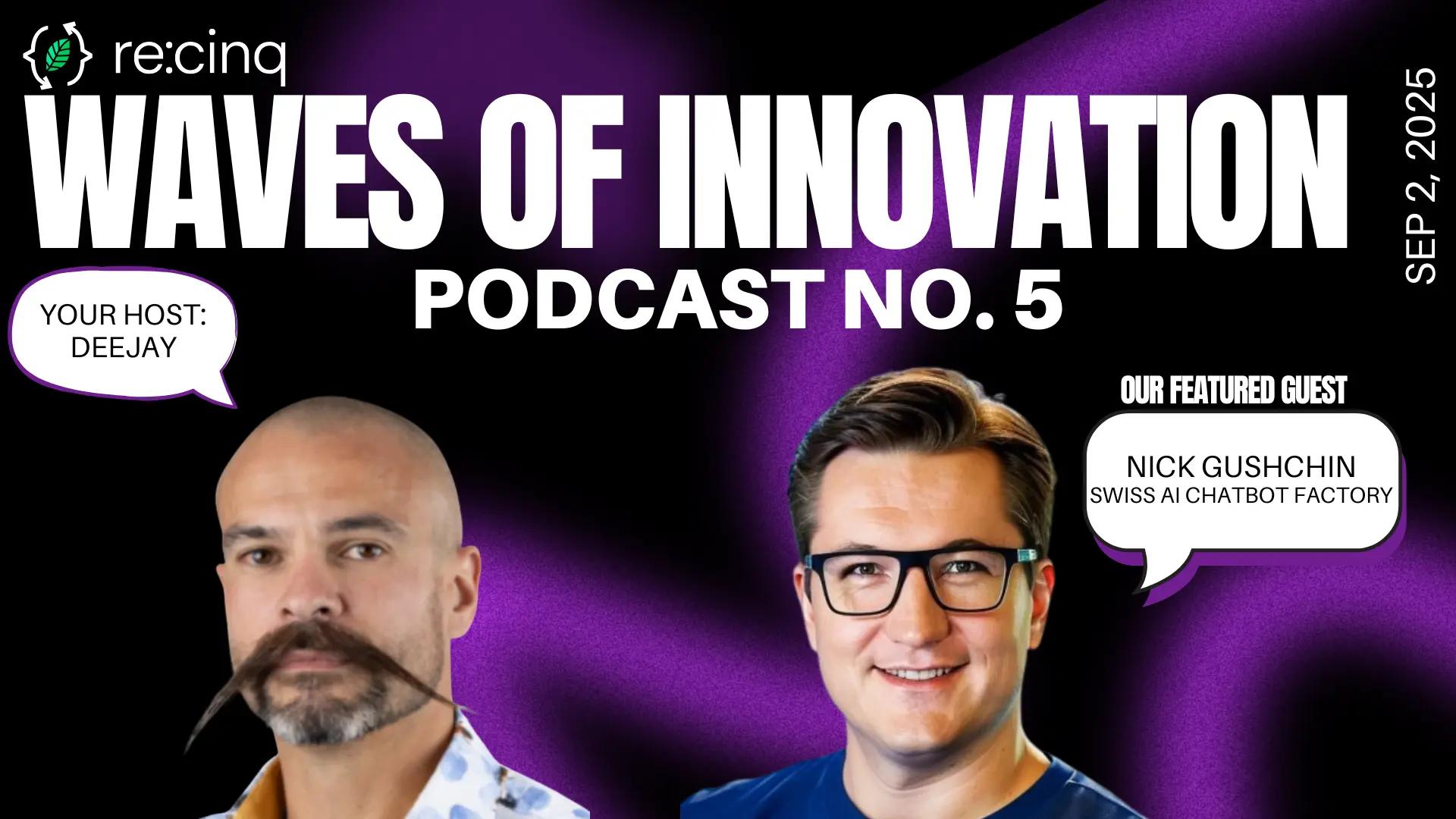
Nick Gushin's journey from 18 years in banking to teaching himself Python with ChatGPT. The develop fast, fail fast philosophy behind Swiss AI Chatbot Factory.
Hosted by
Deejay
Featuring
Nick Gushchin
Guest Role & Company
Managing Partner & Co-Founder @ Swiss AI Chatbot Factory
Guest Socials
Episode Transcript
Deejay intro In this episode, I'm talking to Nick Gushin, who is a co-founder of the AI Swiss chatbot factory. Try saying that company name several times in a row very quickly when you're recording the intro to a podcast. Nick is an ex high flying banker with a five degrees who had a chance encounter on a flight that changed his career path. He now runs a company which uses AI to build AI powered chatbots for customers. In our conversation, we talk about his path to getting there and how it wasn't just a matter of vibe coding and hoping for the best. how having AI on your side allows you to iterate on product ideas much more quickly. And also how we're using different approaches reduces the chances of hallucination in their chatbots. Unfortunately, we had a few audio hiccups. So you might hear some crackling in Nick's audio from time to time, maybe once every five to 10 minutes. And towards the end, his very expensive, lovely professional grade mic ran out of battery. So we had to switch the air pod. So if you hear something slightly different in the audio quality in the last 10, 20 minutes, do not adjust your set, was a problem on our end. Hopefully that doesn't spoil your enjoyment of the episode and with that I will leave you to the conversation. Deejay Nick Gushin, you've gone from being an economics whiz working in banking to starting running the Swiss chatbot factory, which has been quite a journey, or so I gather. And you've done all of this not vibe coding, but actually learning to program properly in Python via the means of LLM instruction, I gather. How did all that go? Tell us about your story. Nick Swiss AI Chatbot Factory Thank you, Daniel, thank you very much for having me. My story indeed is a little bit different from majority of tech guys because I was doing banking for almost 18 years. And in the banking I was predominantly focused on client relationship management and also on people management. So I have five economical degrees, two of them are Master of Business Administration. And I think the last 10 years my role was mostly about management and leading projects, opening new markets, bringing new products. you name it, so quite creative work. But at some point I also realized that there is a limit for the banking creativity which you can bring because just to tell you that to bring to the market any new product, any smart idea which you have, it will take you from 9 to 12 months at a very fast pace. This means that within even your lifetime the amount of projects which you can actually deliver to the market is quite tight. Having quite a good career reaching very interesting levels I came to the understanding that Deejay you Nick Swiss AI Chatbot Factory I would like to do more. by chance, story started with tech, started that I was flying to a conference and I met a guy from Robotics who told me about ChatGPT And this happened literally couple of months after release of ChatGPT. So 3.5 was the smartest model at this moment. and people like crazy at first in the tech community were using ChatGPT What inspired me to make this move and to start testing the technology at this time, so it was end of 22, beginning of 23, was one thing which this guy told me when I was asking him about ChatGPT, what is AI, how it can help us. And also need to tell that in the banking sector we were looking at possibilities and capabilities of AI for quite a long time. But all the time it was very silly models, I would say. So they were not smart. So you had to program and you would expect them, because it's called artificial intelligence, that it would be intelligent. But you would always meet the problem that no, it's not intelligent. having this in mind I asked the guy, what is so cool about this chat GPT and he told me several things. It can write emails, can write messages. I said, okay, I can do this as well and I'm sure that I can, to a certain extent, I'm sure that I can do this. better than any AI at this moment, at this period of time. And then he told me one thing. He told me that this thing can write a Python code for you if you ask it. I said, no, no, this can be true. it means that it will convert, you want to say that this will convert my language, my textual request, my non-structured textual request to the structured code output. And the guy said, yeah, yeah, this is what will happen. I said, This is insane, it cannot be true. If it's true, I think this is the first time since I finished my school when I can try and learn again coding. I do remember I landed in the airport, I immediately uploaded the application and I asked my first question like write me a simple code on Python, because I didn't know Python at this moment, and he wrote me this print, hello world. Okay, so this is a Python, but I think we can go a little bit further. And this is how my story started with the coding. I realized that there is the truth which can actually take my request, and again, it's very important that we as human beings we speak very unstructured language. We speak usually in a very unstructured manner. Also, it's interesting that, for example, when you speak English, it's much more structured than many other languages which exist in the world. And that's why, for example, as far as I read, that if you measure right now IQ level of the recent GPT model, so let's take GPT-5. If you measure this in English and then, for example, in Italian, in English it will be 180 IQ and in Italian it will be lower. And the reason for this, and in Slavic languages it's going even much lower, so 100 something, still quite intelligent. And I spoke with some of the guys from science, so do AI. not use AI like I'm using now, but who doing AI, they said that the problem is that when you actually fine-tune, when you teach the model, the tokenizing in the English language works much better than it works in other languages, because English is already having a very solid structure, like German language as well, and you cannot mess the words around. Whether in some other languages, you would have the situation that you can completely reshuffle the words and still it would be understandable for the person but when you're trying to tokenize it and teach the model it would be much more difficult. Daniel, I need to ask you, I'm talking a lot and I would probably suggest that you can interrupt me because you can see when I start to... Deejay Yeah. Nick Swiss AI Chatbot Factory tell something and I like to speak with people and I have quite a number of friends who calls me to ask something about AI and to listen what I will reply but I know that sometimes this could be too much so please interrupt when I go the wrong direction. Deejay No, that that is absolutely fine. I think the listeners of the podcast much prefer listening to the guests who have the insight rather than me making rubbish witticisms. I was just thinking there were two things that jumped out to me is amusing there. One is that in English having more structure. I think so many people who have emigrated into England and suffered British politeness and trying to figure out what the hell British people mean when they're being very vague. not giving direct instructions might be surprised by that. And the other thing is, I just love the fact that your story started by, talking to a guy when you were flying somewhere, were you sat next to each other on the plane? It was that kind of conversation. this is maybe I've been missing out by being, you know, somewhat introverted on planes and in public spaces of like, I'm the guy that's like noise, headphones on not making eye contact with anyone, but they're. Nick Swiss AI Chatbot Factory Thank you. Deejay I must be missing out on life changing opportunities because you don't know where a conversation might lead. Nick Swiss AI Chatbot Factory It's true. I was flying a lot during my banking times. At some point I realized that this is a moment when a group of people is actually captured together with you in a very small space. But you have something in common. So you are traveling from A to B. and it already brings some sort of the common ground for you. And also, because due to the randomizer, these can be people which might bring something new to your life and some new information, which exactly happened with me, so it was not my first chit chat with a person on the plane. Once I do remember, I'm not in contact with this lady, but I do remember I was flying from Amsterdam with a lady who just purchased some franchise of yoga and she was so excited and she told me a lot of things which I didn't know how does franchise work, why did she had to fly to Amsterdam to buy it and it was so cool to speak with her because she was very energizing and giving this energy to the people around her. But it only started when you asked something. So you say hi, flying, it's cold, hot here, and I was here because I was visiting someone and what do you do? And then it starts. The situation which happened with the guy who introduced me to... Effectively he changed my life. And we are still in contact. He now lives in Japan. He is in robotics, so he is on some senior levels in one of robotics companies. And I mentioned him sometimes, we're from time to time in contact. I follow him, what he is doing. I see that he is from time to time also commenting and following me also. And it's very interesting that, indeed, I think at this moment of time, I was looking for opportunities which will help me to start building my own projects, my own ideas in a much faster way than even executive banking management position would allow me at this point of time. To go further with the story, when I landed, I tested, I understood that yes, it can code. The second code which I asked it to give me was give me a code for a calc. to do a simple math. Then I saw much more lines, still a very small code snippet. And then you start to ask questions. Okay, so if I want to deploy this... even at this time, deploying would be a strange word for me, but if I want to bring my scout later to people, what should I do? So where do I put this code in? Where is my idea? Where is my space? How do I run this code locally? How do I run it on virtual machine? And my story actually started with a very small step, so self-coding. After a couple of months, I realized that I can write the code and I wrote my first chatbot, AI chatbot. So the idea which I came across was that I would use AI to help me to bring and to develop my own AI chatbot. And that was my first project. I developed it within couple of months and this is where I decided that I will make a pause with my banking career because I saw that this AI move, AI trend is taking over the reality or taking over the planet. And I do remember this feeling which I had the same in 2015 when I first heard about Bitcoin because that was the technology which was very slowly starting but it was very clear that it will be very important for people back in 2015 but I didn't have an opportunity and possibility to go deeper into it. with AI I suddenly started to have the same feeling. I realized this is the thing. So if I, a banker, without coding experience, can build within two months, and it was, again, was GPT 3.5, it was not even the tools which are available right now. When I first discussed with a guy, I told that, I think that there will be tools which will code on your behalf, and they will not give you code snippets, but they will give you full applications. I have a friend, is head of data in one large Swiss company and I do remember two years ago he told me this is nonsense, like this will never happen because it's... and he is a coder and he said no no no like AI cannot do this. But in this very beginning I said but if I can use this model 3.5 and I can code Deejay Ha ha ha. Nick Swiss AI Chatbot Factory something like thousand something lines of code. Moreover, I can ask AI to explain me what is written here and I can do debugging myself, I can do further improvement, I can, with the help of AI, I can do all the tests, all the scaling exercises. I understood that this is the thing which will develop further. and it will bring a lot of power to developers, to non-technical people in bringing their ideas life. And of course right now we have these tools like Bolt, Courser, recently I came across Lovable, there was also, I'm using a lot, Repelit and all of these agentic systems where you come with your idea in unstructured language and you can get from it a prototype and this is where I hope we will also touch this base that still my friend was right because the full application, full scale application is still not possible. So, Vibe coding is the thing which is making a lot of fun but it's not really making real products at the moment. But still you can make a prototype and then if you know how to code, if you have developed a project, you know how to debug it. So by saying this, at the moment, over the last three years, I have done my pet projects on Python more than 20. Some of them have become seemingly successful. I have the chatbots, AI chatbots on the Telegram social media which has more than a hundred thousand users and it has like three thousand Mao monthly active users and Dao is a little bit less than a thousand. So and this is done by a person, single person and it's run on a very simple infrastructure and it's a pet project. I would say it's successful because it has this user interaction. So a lot of people using it and people find it useful. besides this, there were 20 more projects. Majority of them would fail and they would fail because they were pet projects. They were interesting for me, but they were not interesting for people outside. So I would just develop them, show to people, and then it doesn't have attraction. Deejay just to kind of contrast that with your banking experience, 20 projects, even if those are, know, majority of them fail because, you know, there's no product market fit. If you were in banking in the same amount of time, you would have maybe got what two projects off of the ground and delivered. So in terms of the throughput, there's a massive difference there, isn't there? Nick Swiss AI Chatbot Factory Yeah, maximum. Indeed, and this still drives me a lot and was driving me in my learning curve. So I realized that I cannot rely... I want to do this MoProject, I have a lot of ideas. And I had a new aggregator, I had some AI interpreters, I had some algorithms of helping understanding user patterns, a lot of things. And we are not yet coming to Swiss H AdWord Factory, so before Swiss H AdWord Factory, but all of this was possible only because I decided to learn coding myself and to learn the full architecture. to deploy even 20 projects you need to know and to understand quite well the protocols, the infrastructure, the cloud infrastructure. You need to be very skillful with all the AP connections, with the exchange of information between your servers and a lot of things which I was learning just by doing and that's why again I'm very happy to be here because I was listening a lot of podcasts of different other people trying to understand what kind of problems they met, how they made through these problems, and this helped me also in my learning curve. Because, yeah, actually my tutors were chat GBT and I was asking it a lot, and YouTube and other platforms where I would listen to the podcasts of the people who are smarter than me. And time to develop was indeed very, very important thing for me because I realized that if I know how to code, if I know how the cloud infrastructure works, I can within a day, and else if I have access to the client, then within the day I can wake up with an idea and by the end of this day this idea will be live in a product mode and already will be given to potential customers and users to have the test and to give me the feedback. In the banking world, this is not possible even with the brightest imagination which you can have. Developing products, I think they have this in the Silicon Valley, this motor. Develop fast, fail fast, and finally find what you can do. Something like this. For me, this is my main motor. So, understand is there a niche for this, and go further. And within the development circle, you get to know every time new things, new protocols, new libraries, new approaches. this, if you do this daily, and we discussed this with you before start of this episode, that when you have a lot of ideas in your head and you want to deliver them, you push yourself harder and harder and this helps you also to learn faster. Like if you cannot accept that something is not possible to deliver or deploy right now, you will always think of this, okay, how can I do this? What is the possible approach? What is the algorithm which I didn't think of before, which I can use in order to solve that particular problem with any of the projects which you doing. Deejay So you were teaching yourself Python through the using chat GPT as a tutor and YouTube videos as well, working on pet projects. At what point did you decide to step away from banking? And at what point did this Swiss AI chatbot factory come into being? Nick Swiss AI Chatbot Factory Yeah, so, and these are two different periods of time. So to step away from banking was when one of the projects gathered more than 1000 customers within a month and private individuals. And this is where I said, okay, I can see that this is something which I like much more than I was doing in comparison to what I was doing before. And by the way, I like banking. think banking is a fantastic industry and it has so much power in bringing positive things to the world. And I don't consider banking as an industry where you just make money. On the contrary, think that the banking is a very fundamental industry for the society because nothing which we have right now would be possible without banking. It's not the only industry, but it's fundamental importance. Our call would never happen. All the technology which we use would never appear. You name it, a lot of things. Deejay all of that financial safety, a lot of people take for granted, especially when they want to bash bankers and complain about the system. But really, like the modern world would not be possible if everyone had their savings stashed under their mattress. Nick Swiss AI Chatbot Factory Indeed, No projects, no progress would happen. We will be very much limited in the speed of development. So transactions, also banking multiplicator, that's banking are taking deposits and giving loans. This is the thing which, and the third layer is of course security and trust which you said, that's central banks around the world they are providing stability to the financial systems of each country. this, I would say these three pillows allowed the humanity to blossom to the level which we are now technologically, scientifically and culturally. But banking is a very steady industry. again, I got a lot of experience. have only positive feelings and memories from that time. But I realized that now with the help of AI, the world would start to change much faster and I would like to join it. having this feeling was one thing, but when I saw this in a practical way, I said one of my projects, which I just launched, a month gathered thousand people, which were using it daily. And for me, that was a moment of wow. I realized that I can try and test a lot of other projects and ideas which I have in my mind, I can do this in a small... My first idea is anyone. I can do everything only with ChudGPT. So myself, my brain, my creativity and the capabilities of LLM, that would be more than enough. And that was, of course, the wrong understanding which I had to realize a little bit later. And this is where Swissair Chatbot Factor appears. But before that, again, stopping with banking or stepping out completely from the banking, I did it in several smaller steps. again, risk approach was important for me. At first, I had a sabbatical. I took a couple of months to learn further coding. And after these couple of months, had this pivotal or I had this milestone, internal milestone. saying, okay, if I would be able to code at the level that I would be able to develop programs myself, applications, then I'm on the right way. If after a couple of months I'm still like blindly going in the dark forest, then it's not mine. And then after two months I realized I started to have a fight with Chagy Pitya because he was... proposing me some approaches which I was saying, no, they will not work or there is a more efficient way to do it. And I okay. And I could write code also myself by that time. Snippets of code were not a problem. And I said, okay, I reached this milestone. The second milestone was I prolonged my sabbatical and I would start to do some commercial projects. And this is where I started to do AI chatbots, releasing them to the market. And again, my question to myself, my milestone was does it have a user interaction? And I gave myself additional three months to understand this. Because coding and developing a product is one thing, but marketing and reaching out to clients is an absolutely different area. Deejay Yes. Nick Swiss AI Chatbot Factory in order to gain, I think, even more important experience in marketing than I realized from coding and learning coding. But then after three months, as I said, one of my projects reached these thousand customers and I sort of started to understand how you move with the projects, how you can not only develop but how you bring them to the market. Then I realized and I wanted to do something more and I decided, okay, this is my life now, so I'm switching from banking to the coding and the AI. At some point, and marketing was one of the reasons for this, I understood that I cannot do everything myself. Of course I can write a code, can create a marketing campaign, but to create all, first of all to understand your clients. to find access to the clients, to create information which is acceptable by your clients, it takes a very deep expertise and also it takes a lot of time. And this is where I started to look for other people to help me, so I realized that it probably makes sense to cooperate with someone. And then at some point I had also around five projects which were live simultaneously and I realized that this is maximum of my capacity. I cannot support more projects and I still have new ideas. And I came to understanding that a couple of these projects were very promising and I said, okay, now I really see that I need other people. And I started to go to conferences. I was sharing my first experience. I was telling people projects which I developed. One of the projects and one of the conferences was two years ago in Zurich, GNI conference, where I was presenting a Maze, a machine learning algorithm for individualized sales yield enhancement. the idea which I'm naming is another thing which you have a lot of fun. Deejay you Nick Swiss AI Chatbot Factory And the idea behind this project was that based on the history of communication or interaction of the user with any chatbot, you can teach a special LLM model and create a system which will make analysis of this communication and will create for you the profile of the user. So like understanding his demographics, so is this person married, what is his age, does he has or he doesn't have kids, what is his... then you go further in psychology, so based on the way how we speak and what kind of language we use, what terms do we use, what words, constructions of the sentences. you can predict using combination of ML with AI, you can predict with a high certainty the profile of the person. So even from a simple chit chat. I was amazed with this idea and I tested it and even with in 2024, yeah it was 24, even at this time the cost of such analysis was extremely low if you would rely a lot of aspects on LLMs. Deejay We're just, to jump in there on specifics. Kind of what kind of order of magnitude costs you talking about that? Because I was working with a customer last week who was quite concerned about some various different machine learning, proof of concepts that we were proposing to them about the operational costs of those. And we're expecting everybody's heard that LLMs to train themselves cost billions. And that kind of seeps into people's knowledge that even just using these things is going to be horrifically expensive. Just to an order of magnitude, roughly how much were those things costing to either run or to train? Nick Swiss AI Chatbot Factory I was using quite, I would say, for me it was efficient approach. So from day one I realized that technology with LLMs, having big companies like OpenAI, then Google joined the race, then you have Entropic, then Elon Musk with his axe, with Grog, even having these guys. on the radar you understand that development of your own LLM will be, at least for me was the answer, would be always a bad idea unless I'm doing something very specific like for example for I don't know in science, a pure scientific industry which works with a lot of sensitive data like medical sector. I think this is the area where you would probably your own model because you need to have a very controlled environment. But when we talk about 99.9 projects which people discuss and brainstorm and create right now, 99.9 projects should be, in my view, should be powered by the most capable LLM models. All of them have a possibility to fine-tune. So that's why my approach when I was developing on this project was that I would take 3.5, at this time still, 3.5 from OpenAI and I would fine-tune it on my dataset. And even datasets, I could use something from my previous project, but then I would anonymize it and I would create a bigger data set again using LLM. So showing to LLM the samples, anonymized samples, and I was asking, okay now create a sample which is thousand times larger or million times larger than this one. It takes time, it takes money, but at the end of the day when you calculate even with these fine tuning exercises We're talking about hundreds of bucks maximum. With ML it's a slightly different machine learning. A simple machine learning exercise you don't require external support. You can do it on your own machine. You can create the model yourself and you can train it yourself. I was combining these things, so I was using my local self-developed ML and fine-tuned the chat GPT 3.5. And the thing is that it was giving very interesting and very good results, so of course I tested it mostly on myself, whether it would understand who am I from my just my WhatsApp communication with some people. I was downloading and giving it to Maisy to make analysis of myself and it was doing quite well. And the cost of this was that the single analysis was effectively costing me a fraction of the cent because... Again, if it's pre-trained and fine-tuned model and you have built an algorithm how this data is processed, then it's a one call to OpenAI and with a predefined prompt using your pre-trained fine-tuned model, for one person you don't need to do it multiple times, you do it once and it's a fraction of a cent. This case I was presenting on the one conference. and my current co-founder, my friend of mine now, came to me after this one. So we didn't know each other and he came and said, look, I was listening to you. I realized that you have some other projects and ideas because I was sharing with people that I'm looking for investments, but investments not in terms of money. but I would like to work more with people that I could deliver together with them more and more scalable projects. So I was inviting people to get in touch and to look together on what we can do. And then Robert came to me and said, look, I live a long life in the coding environment, in data science. I have developed these and that projects and I'm also quite curious to see where the AI wave can bring us and what we can do as a community. And we started to work with him. Funny enough, I had at this time a couple of requests of developing AI chatbots, but for the companies. And this is where we started to do it together. Robert. And at some point we realized that our chatbots are much smarter than the regular chat. The problem of the chatbots, especially when you go to the website, is that all of them are silly. like, majority of them are dumb. And the problem is that they are usually done by people with a very good and high skills in programming, but it's very hard to bring the proper sales logic inside the bones or relationship management. And that's why majority of bots, even before AI and even after AI era started, they have this problem that people try to pre-define communication with the user. And then you have these fallback scenarios. When you ask something and the chatbot says you, I don't know, please contact the support. Or he understands you wrong. Or he's providing you non-relevant big snippets of information, which you don't want to read because it doesn't help you. And that's why people think usually that chatbots are dumb. So we were doing this manually and we realized that we already disrupt the chatbot approach because our chatbots were not dumb. I was reusing here a lot of my banking experience, relationship management, building a relationship with the customer, sales logic, and also we were bringing the most recent developments in the AI. So we were using the latest AI models. We were using a lot of prompting. We were working with hallucinations from day one. And we were testing different approaches. How do we combine the proper dialogue so that the person doesn't feel that he speaks with the robot, but also with a high quality that we can deliver. the result which will be very accurate and very data-driven but in the form of regular communication. And we were doing this couple of times and then we realized that we had the brainstorming session with Robert when we discussed that if we carry on like this, okay, again, we will bring... Yeah, maybe 12 chatbots a year or maybe 20 because every time when you deliver a chatbot, follow and I think this was the success of our chatbots that we were making a lot of research before we start building the chatbot. I would go to the company website, I would understand what it is doing. We would make a forecast what kind of clients or we would make assumptions what kind of clients would come to this chatbot, how they will speak, what kind of information do they need and all of this logic we would then bring to the development of chatbots. Also we would take the data from the company, we would make It's normalization. When you speak with an enterprise, usually people say, yeah, let it speak just on behalf of our company, but we have some data sets, some standard agreements, have something on our website, we have something here and there, and this is our knowledge base. And let the chat board speak on behalf of this data. But if the data isn't structured, you have a problem that's your chatbot doesn't know to which area to go in order to pick up the relevant information. Also, it can be conflicting and very often it happens for many companies that they have conflicting information and we had to sort all of this out. So when we were creating a chatbot, we would make a pre-analysis, we would go inside the data trying to understand what is relevant, what is not relevant, eliminate this misunderstandings or conflict of information and then we will build their interface layer and we'll give it to the company. In this process it consists of eight steps. We realized that if we would automate some of these processes with the help of AI agents we would be much faster. And then we were having a brainstorm session once and we said, okay, but can we automate the full process? We did it multiple times, so we know what has to be done, but can we develop for each step a separate AI agent which will speak with a predecessor and will speak with a follower guy and they will do everything what we do but without us. So in the beginning we said, yeah, and... It was quite obvious that we can try to do it, but not clear is it possible or not. And the first beta project of Swiss Air Chatbot Factory was creating a website within 10 to 20 minutes, because we were able to actually replicate all our logic, what we do. We were given its website information, it would read the data, then structure the data in a certain way, create RAG creates a special layer of defining which silo within the data is responsible for which information and then we create the layer which is controlling the hallucinations and false information and then we would wrap it into the visual chatbot widget and send it to the customer. So, and this is how the Swiss AI Chatbot factory started. very important thing here that we started with doing this with our hands first. So we knew the project, we knew all the process, we were developing it multiple times, and we were quite clear with all the problems which might appear. And then, because we were quite advanced, both of us at this time in AI technology, we realized that we can build AI agents to replicate our actions in each of these steps in creating a chatbot and effectively to give the power to AI to create. So right now after more than a year of Swiss AI Chatbot Factory being live, the period of creation of a chatbot right now is less than three minutes. So it can be done by anyone. It doesn't require any skills, so the person comes to the portal, opens the portal, portal.swiss-bot.com, register there, click the button, create a new chatbot, and gives his URL address, and then takes his fingers off the keyboard, and he's lucky if he has time to go and take one coffee, because usually it will be developed even faster than this. And then within three minutes he gets back the fully trained AI chatbot, which knows what his company does, which knows all the information, which can speak on behalf of the company, rely only on factual data, speak all the languages possible for communication, understand non-linear requests, because the problem, the biggest problem, one of the biggest problem is always... that people speak in a very strange manner. So we have typos, we ask questions differently, we want to speak in the way that we speak, we don't want to structure our sentences that a robot will understand it. We would speak with a chatbot like we would speak with a real human being. And our chatbot understands this questions because it's always see the question from the angle of the chatbot and the website which is standing behind it. So we have a dozen of clients at the moment, some of them quite big Swiss companies with a big traffic on their websites and we are quite happy with the product. Nick Swiss AI Chatbot Factory So let me in this regards tell about the story which I like a lot about understanding how AI works. And this is a story about the GPT-5 model. So when it just appeared, a lot of people tested it and wanted to understand how smart is the model. And one of the funniest thing was that some people asked it if I have a mug and they seal it on the top and they cut the bottom can I drink a water from it and the answer of gbt5 the smartest model on the planet at this time was that no you cannot drink and people of course were making a lot of fun saying yeah look how stupid AI is because like we as a human beings understand that if you have a mug and it's sealed on the top and cut on the bottom, you just turn it around. But for some reason, the smartest model didn't understand. And everybody was making, haha, look how silly is the AI. For me, it was a different question. I realized that, no, the problem is somewhere else. I cannot believe that GPT-5 doesn't know this. It's a very smart model and I'm going to build some applications using this AI. So I need to understand what is the problem. And the answer was quite, actually I found quite fast. I copied the same prompt and then I provided additional request, additional information which would shape the response of the model. And I was telling that on top of the initial prompt, I was telling that I don't care how we name parts of the mug, whether it's bottom or whether it's top. For me, what is very important is that I just need to drink water from this device after the exercises which I performed with the sealing and cutting. So please let me know how can I do this. And immediately, GPT-5 replied that just turn around the mug and you can drink from it. it's, and this is the, the one of the good examples of understanding how LLM and how LLM models work. That's in order to get a good quality results, you need to understand and you need to provide it with enough of information. You need to give it a very clear instructions and you need to be very specific in what kind of results you expect. So, and then you will get a lot of productivity and a lot of good results out of these models. But don't expect that AI is a magic pill which can solve all the problems. You need to be experts in the field. As with Swiss AI Chatbot Factory, we were experts in building AI chatbots which speak like humans and the same... If you're building something with the help of AI, you need to be an expert in the field which you are building. And this will result into the good projects. Deejay On the subject of quality of outputs, earlier you mentioned that the Swiss AI chatbot factory has a particular layer in it to help reduce hallucinations. What's the general strategy there? Nick Swiss AI Chatbot Factory Yeah, indeed, maybe I would not be able to reveal the detailed structure because then, yeah, and also it can be used for the purpose to test us and I wouldn't want to give this opportunity quite broadly. the approach is the following still. think we came to this approach also after making Deejay Secret sauce. Nick Swiss AI Chatbot Factory a lot of tests and consulting with experts on the market check and the best use cases. The approach is the following, that whenever user interacts with a chatbot, first of all, the first rule, it's never allowed that the request of the user goes directly to the function which is preparing the reply. It's forbidden. So between the user inputs and actually the processing of the reply, there are several layers of AI agentic checks and research. while the input is processed, it is checked whether it is related to the content of the website or not related. whether there are some definitions of the type of the charts which we are performing, so whether I would call it a simple cheat-chart, or whether it's a request of the data, or whether you can see already from the very beginning that this is an attempt to abuse or to jailbreak or to actually use wrongly your chatbot, so ask non-relevant information. So this is the first layer and the first step. on this layer, and again, we use AI agent, which is performing this analysis, and then it's rerouting further the input. Then input would go to the preparation of the answer. And again, if it's a chit chat, then you don't need to upload all the data of the company. But if it's a request of... Do you have an office in this particular city? Then you have to rely on the data. And this is where we use a rug approach. we use all the data is vectorized. But also we actually have two databases for each website. We use a vector database and we use a textual linguistic database for linguistic search. And then we perform simultaneously search in terms of vector search and also linguistic search. And then we have certain internal rules to compare the reply, to assess whether this reply is correct for the inquiry or whether it's fitting or not fitting. And for vector, you can do this based on the probability, on the similarity score. So you have some thresholds, whether if the similarity is below something, then it's non-relevant information. If it's higher, then it's above. But on top, if you bring also linguistic results, so independently from vector search, you made a textual search and you found with the help of AI, not with a control F, but you ask AI agents to read the data from a relevant data silos. and to assemble and to understand the reply and then you can combine vector with a linguistic and then you have another agent which is assessing the initial request, the outputs and also the background data of the company which we're having whether it is correct or not and only after this the user would get the response Given the current level of technology, all of this takes a fraction of a second. So there is no delay. The person sees this as a regular communication. You ask and then you get the reply. But behind you have this detailed pipeline which allows us to eliminate the situation that people just get inside the data and get inside the LLM and try to jailbreak it, or they look for some non-relevant information, or that the board is providing the wrong information. There are also some rules that if information is not found, then there is a very strict protocol what LLM is allowed and not allowed to do, again with additional controls in order to prevent hallucination. We had a very interesting test back in time that at one of the models and And by the way, we're using not a single model. We're not only relying on OpenAI. We're relying on several providers, which in our pipeline, we use different LLM models in different AI agents. And we tested thousands of times different combination. And now we know what is the best way to service the whole pipeline. But at some tests, we found that very funny thing that If, for example, there is a content or in the history of the child, the LLM sees that the user was very aggressive in his communication with the model, then the model tend to hallucinate the answer which will fit the or which will please the user in a Deejay You Nick Swiss AI Chatbot Factory Testically high level. Yeah, so the the probability of hallucination was again based on the thousands of tests which we ran in this situation was coming to more than 90 % so that's Effectively in this was like this was like a pattern for hallucination. So if you Aggressively speak with the model if you push it then it will answer whatever you want And it will create the data without actually relying on the real data. That was a very scary thing. And the only reason how to work with such things is, as I said, to have a very detailed pipeline of how your information is getting inside preparation of the reply, how the data is retrieved, how it's processed, and then also how it goes back to the user. This is why we call Swiss AI Chatbot Factory, it's a factory, because it's like on the conveyor of the real factory, both when we create a chatbot, but also both when we prepare the reply for each single user request, that it goes through a conveyor where certain AI agents take the information, process it in the way, make the assessment, put a stamp on it. and then process and give it further to the next conveyor entity. This is why we call it also factory. It's really factory now, understand? Deejay Yeah. And the, the, kind of meta level of you using AI to build AI chatbots, I think it's, you know, the, the, in terms of the wider implications for the industry, I think that's a good example of how, if you just take things at first glance, the, the amount of change that is likely to happen doesn't become apparent to you. When once you've done this, you've built some chatbots that use AI to provide their answers. And then you realize you can use AI to build the AI chatbots. that provide those answers. That higher order thinking is where the big impact starts to come. And in terms of impact on the wider software development industry, the fact that you were able to, with a few months of swatting up yourself and learning how to use Python and use these tools, generate 20 different prototypes in a short amount of time. That to me suggests that the traditional software development kind of process. and product management and prototyping and exploring user needs should probably be paying attention to that kind of thing and adopting that sort of approach. Nick Swiss AI Chatbot Factory Yeah, to be fair and frank, my circle of learning Python, so the time when I really felt that I use this language professionally, I'm not having any more blind spots. I don't know all the libraries. For me, I think it's impossible. But the concept and the approach is so clear for me that I can use in Python. and having AI agents like GPT or any other system which will help me to code, I can code a lot of things, if not to say almost everything. So the whole circle took me nine months plus. And it was very interesting that in the beginning it was very steep learning curve. So you get your first information, you get your first functions. you understand how you develop variables, how you exchange variables, and then you think, it's so easy, and then you go, go. And then once you come to the really big projects, so where you have multiple servers, when you need to deal with databases like Postgres, when you need to have external web hooks, and again, many, many, many other things to build a proper industrial product, then you come to the situation, oh, there is so deep and I need to learn many, many things. So I would say again, learning something from scratch. And I think this nine month period is a very accurate periods if you do it daily. And I was doing this like a daily job. was, I was coding 12 to 14 hours a day, almost nine months. So it's Deejay Hardcore. Nick Swiss AI Chatbot Factory It's not that I wake up two hours of coding and then I go somewhere else. No. It was really a full-time job, which I liked and enjoyed because every day I was solving a different problem. I was going a little further and I felt that I had this feeling that if I learned this, I will be able to do more. But nine months of hardcore coding... spending very little time with your family, spending no time with your friends, only maybe some calls of my friends which were calling me and asking what do you Python and they were telling you're crazy, stop doing this, you're a banker, you shouldn't do these Have you had your sabbatical? Please come back to banking and don't carry on with what you're doing. I'm very happy to have this conversation today. think looking back, not everything which I said was very specific. Even I tried to bring some specific things, but I'm more than happy to get in touch with people. So if anyone would be interested to follow up on something of what we have discussed in more details. I'm more than open, so on LinkedIn, on X, yeah, these would be my two main platforms. LinkedIn would be the main one. And also for the people who would like to test and try Swiss Air Chatbot Factory as a technology, we have a special present all the time. It's a blue helmet, blue helm with the logo of Swiss Air Chatbot Factory. that people can feel themselves that they were part of and now they are part of this factory approach but where AI agents is working and they're doing this disruption level AI chatbots which are finally smart and answer the questions in the way you want it. So I'm sharing this also with people who would test the technology and write me back and say what they liked or they didn't like. So we are giving away this real help. So you can use it on your daily construction work if you're engaged in any. Deejay Excellent. So people can look you up on LinkedIn via your name Nick Gushin, which will be spelled in all the places we publish the podcast, what's your X handle and how do people get in touch if they want to test Nick Swiss AI Chatbot Factory I So the X is the same, so Nick Wushen I will send you the link to it that we can edit and SwissBot, Swiss AI Chatbot Factory has the following web address so portal.swiss-bot.com So you get there and you get to the portal where within three minutes you can create any chatbot, test it, speak with it Deejay Excellent. Nick Swiss AI Chatbot Factory and see the things which we were discussing. So behind all these processes, all this conveyor which is happening, you can see in the real life how user-friendly and easy it looks like when you're coming to test it. Deejay Excellent. Cool. Right. Well, thanks very much, Nick. Thanks very much for your time. And hopefully we'll speak to you again. Nick Swiss AI Chatbot Factory And thank you so much and wish you lovely rest of the day. Deejay Hopefully you enjoyed that chat and I found it really quite interesting the angle of how Nick was able to iterate on product ideas that quickly. If one individual can do that, then what does that mean for products, organizations and prototyping inside the traditional software delivery process? I also think it was interesting looking at their approach to reducing the chance of hallucinations. Often when you talk to people about their fears of LLM powered chatbots, They assume that you just pass the prompt from end users directly to the LLM and that doesn't seem to be a sensible case and not a very realistic one either. If you have any feedback on the Waves of Innovation podcast, then please do email us at waves-of-innovation@re-cinq.com. That's re-cinq.com and otherwise be good to each other and you'll hear me in the next one.

Episode Highlights
After 18 years in banking, Nick's journey began when a stranger on a plane revealed ChatGPT could write Python code from a text request.
Using ChatGPT and YouTube podcasts as his tutors, Nick taught himself Python from scratch, starting with a simple hello world command.
He decided to leave banking for good after one of his personal chatbot projects attracted over a thousand active users in its first month.
Out-of-the-box foundation models were not viable for their use case, showing only 20-30% accuracy on real conversations.
Embracing a develop fast, fail fast philosophy, Nick built over 20 pet projects on Python to accelerate his learning and test ideas.
He met his co-founder, Robert, after presenting his machine learning algorithm at a Zurich conference where he was seeking collaborators.
They began by manually building smarter AI chatbots for companies, combining Nick's sales logic with the latest AI models.
After repeatedly building chatbots through an eight-step process, they decided to automate each step with its own dedicated AI agent.
This automation became the Swiss AI Chatbot Factory, a platform that creates a fully trained chatbot from a URL in under three minutes.
The factory's conveyor pipeline uses multiple AI agents to check input, retrieve data, and prevent hallucinations before delivering a response.
Related Episodes
Share This Episode
https://re-cinq.com/podcast/the-banker-who-built-an-ai-factory