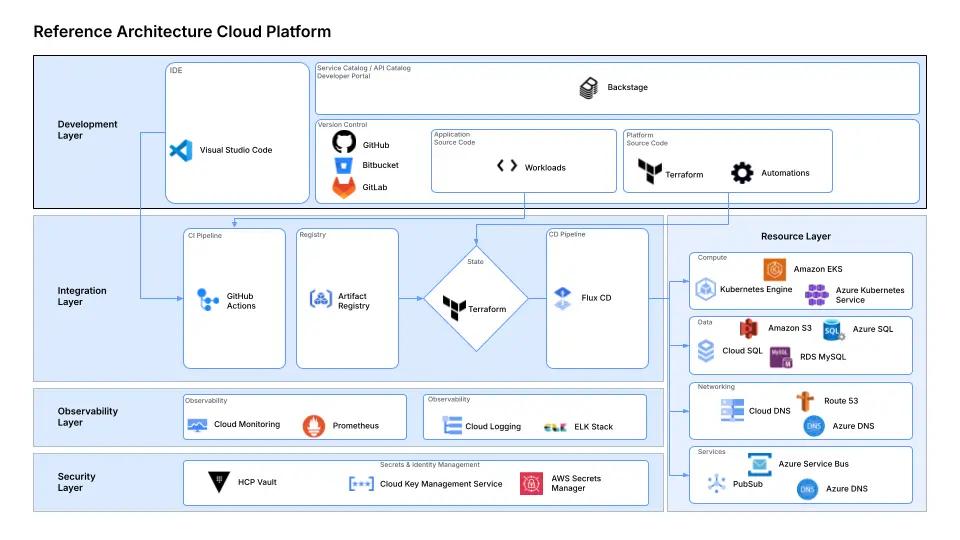
Understanding Platform Engineering#
As organizations navigate the complex landscape of cloud computing, artificial intelligence (AI), and Retrieval-Augmented Generation (RAG), platform engineering emerges as a critical foundation. By providing a standardized, self-service platform for developers, it empowers teams to focus on innovation while ensuring operational efficiency and scalability.
Platform engineering is the discipline of building internal platforms that streamline the development process. It aims to provide developers with the tools, services, and workflows they need to manage their applications effectively, without being burdened by infrastructure details. This empowers teams to focus on delivering business value and accelerates time-to-market.
The Role of Platform Engineering in Cloud-Native, AI, and RAG Platforms#
Platform engineering plays a crucial role in enabling organizations to leverage the power of Cloud-Native1 technologies, AI, and RAG. Here are some ways platform engineering can support these technologies:
Cloud-Native Environments#
- Infrastructure as Code (IaC): Platform engineering facilitates the adoption of IaC, enabling developers to define and manage infrastructure using code, ensuring consistency and reproducibility.
- Containerization and Orchestration: Platforms can provide standardized tools for containerizing applications and managing their lifecycle using orchestration platforms like Kubernetes.
- Serverless Computing: Platform engineering can abstract away the complexities of serverless functions, allowing developers to focus on writing code without worrying about infrastructure provisioning or scaling.
AI and Machine Learning#
- Data Pipelines: Platforms can streamline the creation and management of data pipelines, ensuring that data is collected, processed, and stored efficiently for AI models.
- Model Deployment and Management: Platforms can provide tools for deploying and managing AI models, including version control, monitoring, and scaling.
- MLOps: Platform engineering can support MLOps practices, enabling teams to automate the entire AI lifecycle from development to production.
- Data Retrieval and Indexing: Platforms can provide efficient mechanisms for retrieving and indexing large datasets, which are essential for RAG systems.
- Query Processing: Platforms can optimize query processing to ensure that RAG models can efficiently retrieve relevant information from large datasets.
- Model Integration: Platforms can facilitate the integration of RAG models with other components of the application, such as search interfaces or chatbots.
Key Benefits of Platform Engineering#
By adopting platform engineering, organizations can experience a range of benefits, including:
- Increased Developer Productivity: By automating routine tasks and providing self-service capabilities, platform engineering frees developers to focus on building innovative applications.
- Improved Efficiency: Standardized tools and processes reduce inefficiencies and ensure consistent practices across teams.
- Enhanced Scalability: Platform engineering enables organizations to scale their infrastructure and applications seamlessly to meet growing demand.
- Reduced Risk: By automating infrastructure management and implementing best practices, platform engineering can help mitigate risks and improve system reliability.
Platform Engineering for AI Native, in Practice#
In the year since this post first went up, the platform team's job has expanded. Self-service Kubernetes, IaC, and CI/CD pipelines for product engineers still matter. The team now also has to cover the layer of AI agents and copilots sitting inside the engineer's workflow — making that run safely and predictably, with the same operational rigour as the rest of the stack.
A few patterns have shown up consistently in the AI Native engagements we've run:
- Model access as a platform capability. Hosted endpoints, governed prompts, vetted models, and an auditable trail of which agent called which model against which artefact. Without this, every team integrates differently and the platform inherits the security and compliance debt later.
- Evaluations move next to CI. Test suites for prompts and agents — not just unit tests for code — run on every change. The platform team owns the harness; product teams own the rubrics. Research from GitClear and Sonar showing AI-generated PRs carry significantly more issues than human ones makes this non-negotiable.
- Reference architectures stop being optional. Teams adopting AI tools without a shared template create five different RAG stacks in six months. A platform-owned reference RAG pipeline — retrieval, indexing, governance — saves the architecture review that happens later when something breaks in production.
Platform engineering for AI Native looks like platform engineering for Cloud Native with a new layer of governed AI components added underneath the existing self-service surface.
Conclusion#
Platform engineering is essential for organizations that want to leverage the power of Cloud-Native technologies and AI. By providing a solid foundation for development teams, it enables them to innovate faster, reduce costs, and deliver better products and services. As the complexity of modern applications continues to grow, platform engineering will play an increasingly important role in driving business success.