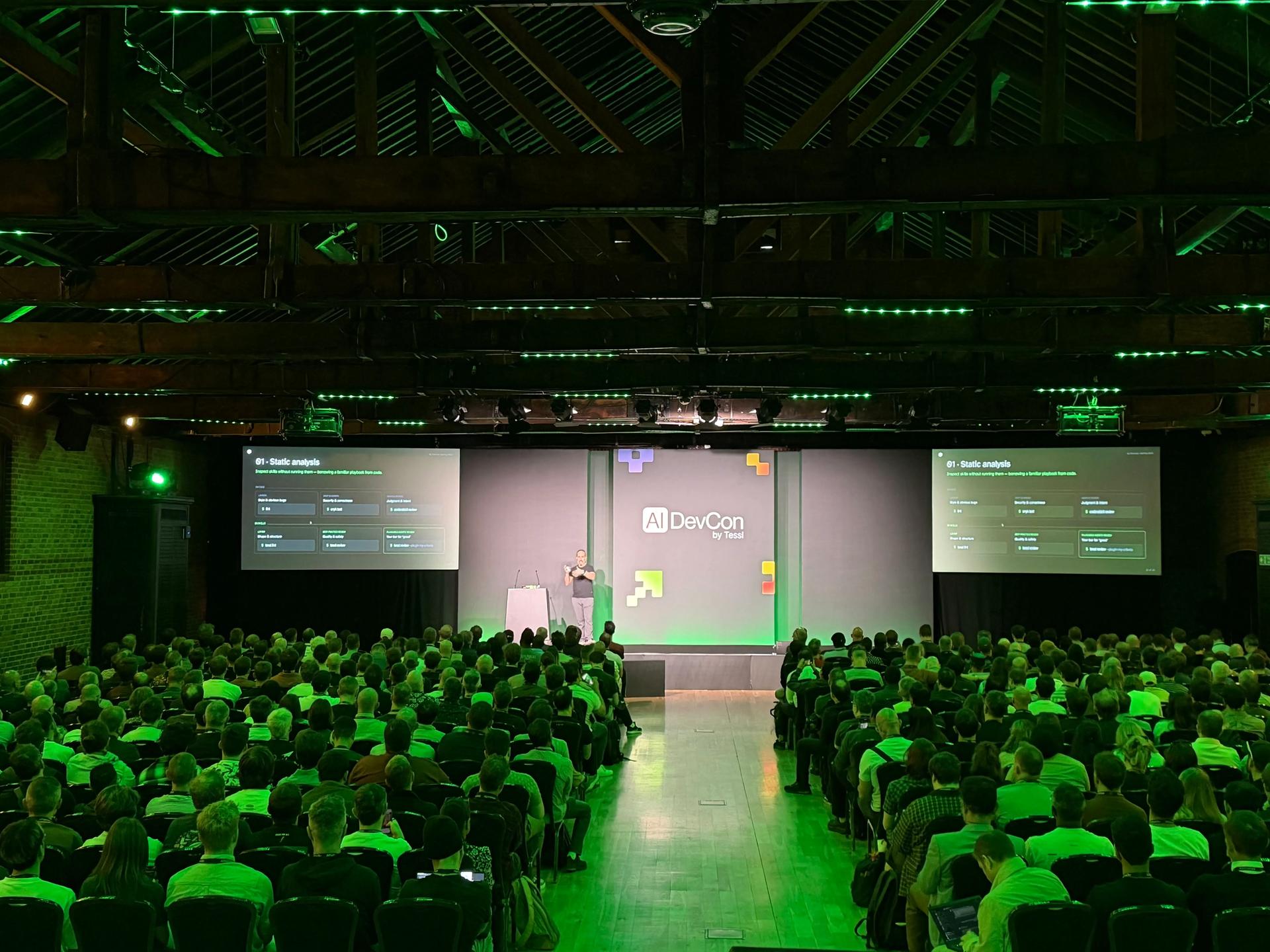
On June 1–2, we attended AI Native DevCon 2026, organised by Tessl, at The Brewery in London.
It was clear from the start that a lot of care had gone into the event. The venue was excellent, the food was consistently good, and the whole conference felt well thought through. Before the event began, several speakers, including Pini Reznik and Daniel Jones, were invited to a private dinner on a boat along the Thames. With sunny weather over London, it was a strong opening to two days of conversations about where software development is heading.
re:cinq was there as a sponsor, with our own booth and a team made up of Pini Reznik, Daniel Jones, Michael Czechowski, and Chris Black. Across the two days, around 600 people attended the conference, and we had a steady stream of conversations with engineering leaders, platform teams, product leaders, and people trying to understand what AI Native development will mean for their organisations.
Deejay and Chris at the re:cinq booth at AI Native DevCon 2026
The level of interest was noticeable.
Many people came to us with questions about agentic coding and our CodeGenAI training. Others wanted to talk about AI Native transformation, software factories, platform strategy, and what it really takes to move from experimentation to adoption across an organisation. The conversations made one thing very clear: demand for AI Native services is growing quickly. People are no longer asking whether AI will change software development. They are asking how fast it will happen, how to prepare their teams, and what they should do before the gap becomes too large.
From pipelines to prompts#
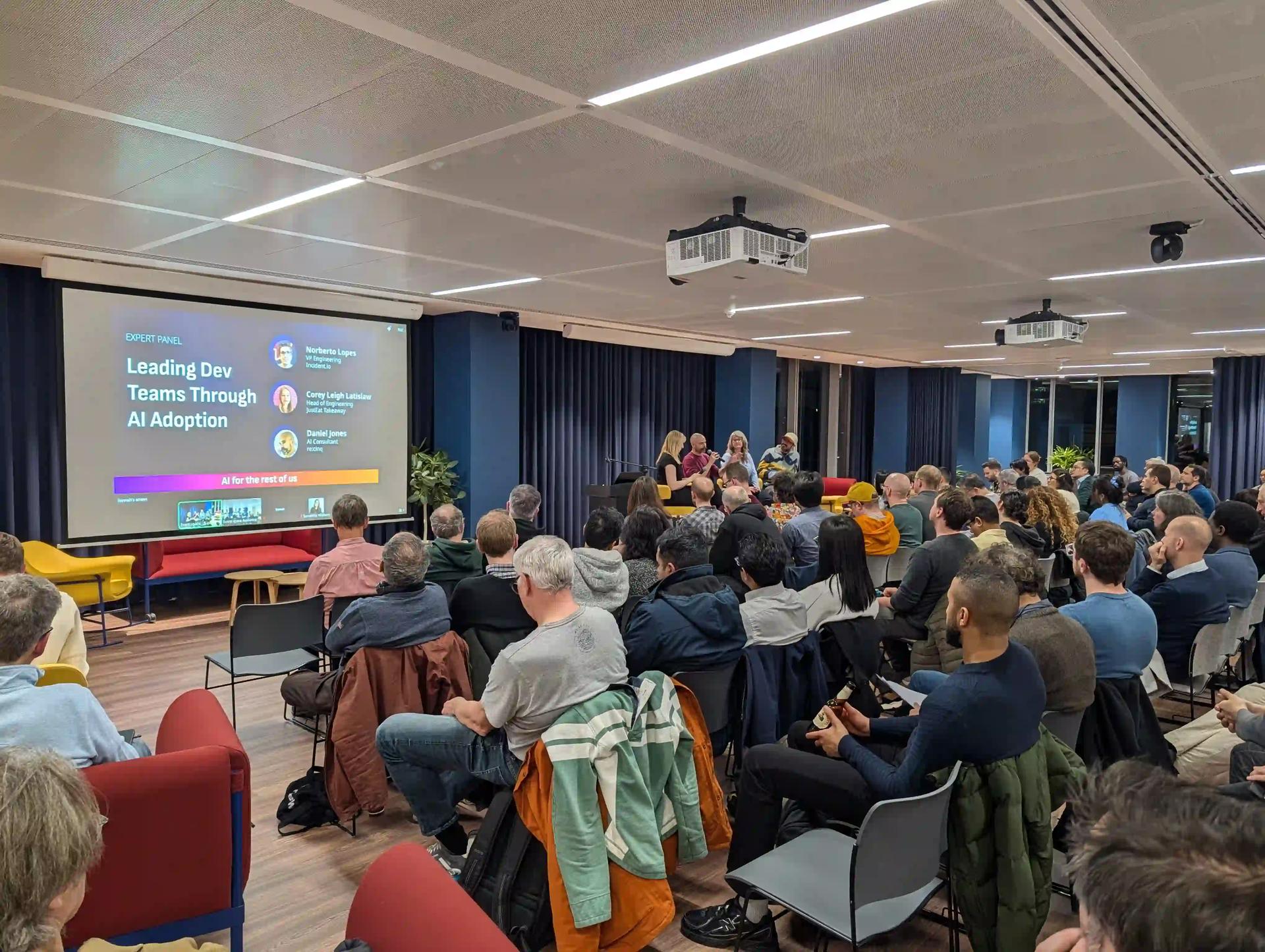
Pini Reznik joined a panel at the beginning of the conference titled:
From Pipelines to Prompts: Surviving the Shift to AI
Pini Reznik on the From Pipelines to Prompts panel
The panel explored the shift from Cloud Native and DevOps-era thinking toward AI Native development. The people in the room have already lived through major industry changes: cloud, DevOps, DevSecOps, platform engineering. Now the question is whether the practices that helped organisations survive those shifts are still enough for the next one.
The discussion focused on what still holds, what assumptions are starting to break, where the hype is ahead of reality, and what is quietly becoming foundational.
For us, this is one of the most important conversations in the industry right now. AI Native development is not just a tooling change. It affects delivery models, architecture, team structures, leadership, governance, and the way organisations think about software itself.
Odevo's AI Native transformation#
Daniel Jones also spoke together with our good friend Tomasz Maj from Odevo in a packed session titled:
More Software, Faster — Odevo's AI Native Transformation
Daniel Jones and Tomasz Maj presenting Odevo's AI Native transformation
The room was full. People were standing outside because there was simply no space left inside.
That level of interest says a lot. The industry has heard enough abstract AI promises. People want to know what actually happens when a large organisation moves beyond pilots and starts bringing AI Native workflows into real execution.
Daniel and Tomasz shared the story behind Odevo's transformation. Not the polished version, but the real one: why the company started moving toward AI Native workflows, why licenses and workshops are not enough, what cultural and operational friction appeared along the way, how agentic coding and AI-enabled product management changed the way teams worked, and what measurable outcomes came out of it.
The session was especially valuable because Odevo's story is not about a small experiment in an isolated team. It is about the reality of change inside a large organisation, where technology, leadership, culture, and execution all have to move together.
You can watch the full recording here: Odevo's AI Native transformation, the full session on YouTube
A book signing, and not enough books#
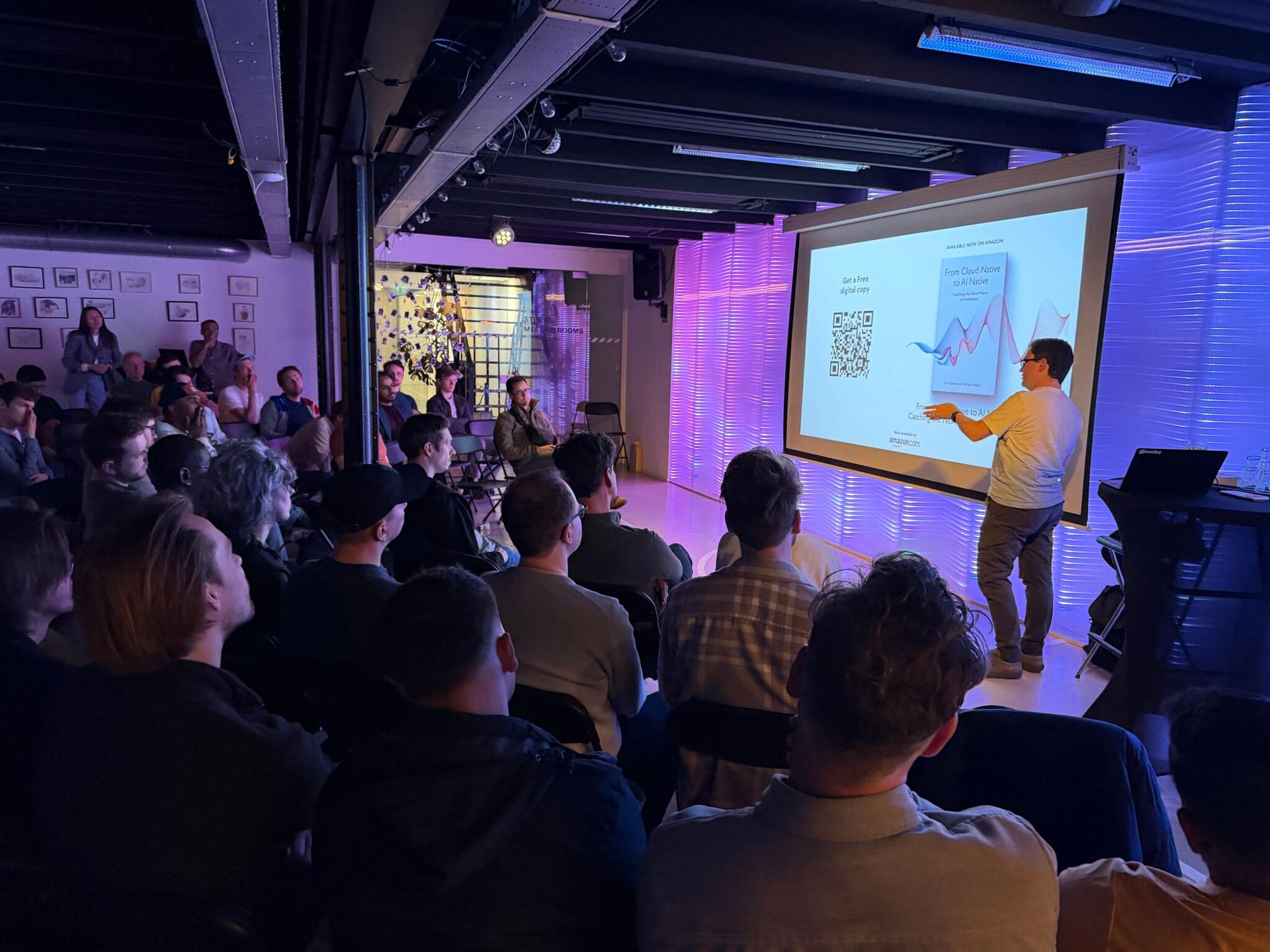
Pini also did a book signing for his book, From Cloud Native to AI Native.
Pini Reznik signing copies of From Cloud Native to AI Native
Unfortunately, we did not bring enough copies for everyone who wanted one. That is a good problem to have, but still a lesson learned. Next time, we will bring more.
The interest around the book matched what we were hearing at the booth. People are looking for a clearer way to think about this shift. They want something beyond tool comparisons and productivity claims. They want to understand what AI Native means at the level of teams, systems, operating models, and leadership.
Raffle winner for our CodeGenAI training#
At the end of the conference, we also ran a raffle at our booth. One person won a free ticket to our public CodeGenAI training in Amsterdam, worth €850.
The raffle winner at the re:cinq booth
The winner was announced at the event and was very happy with the prize.
For anyone who missed the raffle but still wants to join the training, we still have a few early bird tickets available here:
CodeGenAI training in Amsterdam, early bird tickets on Luma
The training is built for engineers and teams who want to go beyond basic AI-assisted coding and learn how to work with agentic coding, AI-enabled workflows, and practical development patterns in a hands-on way.
The shift is becoming visible#
Overall, AI Native DevCon was a strong event and a clear signal of where the market is going.
People are starting to realise that AI is coming into software development quickly, and that waiting too long is becoming a risk of its own.
A few themes came up consistently in our conversations. Many organisations are already experimenting with AI, but adoption is uneven across teams. Some engineers are moving quickly, while others are still hesitant or unsure how to use the tools in a meaningful way. There was also strong interest around agentic factories: how to move from individual productivity gains to new operating models where AI agents, engineering workflows, product thinking, and delivery systems work together.
Some companies are still figuring out where to begin. Some are already experimenting. Others are looking at how to scale adoption across entire engineering organisations. But the direction is becoming clearer.
AI Native is moving from an idea into an operating reality.
We were glad to be part of the event, grateful for all the conversations, and excited for the next ones.