EEEG: A Substance Test for Content in the AI Era
AI-written content gets skipped on sight, but the same filter catches writers using AI to publish real substance. EEEG is the test we use at re:cinq.

 6 mins read
 18 May 2026
This is the first of two pieces on what the content shift looks like once you stop treating AI as a yes/no filter. Part 2 looks at the deeper problem AI is starting to expose — that good ideas have always been distributed unevenly to people who can also write and reach an audience.
Most people now skip anything that looks AI-written. Publications have made it formal — Clarkesworld closed submissions in 2023 when AI-generated content overwhelmed its inbox, and several academic journals have banned AI-authored manuscripts.
Most of the time, this is the right call. Writing with AI is almost free now, and most of what gets published with it isn't worth reading — SEO content, LinkedIn posts written by a model from a prompt, books no one asked for. Skipping it is fair.
The problem is that the same reflex catches a different group too. Some people know useful things but never write them down. They're engineers, researchers, architects, operators — people who know their field but don't write. AI gives them a way to publish for the first time. They have the substance; the model handles the writing. Their pieces get skipped along with the slop, by a filter that can't tell the difference.
Cars and horses
This is what often happens when a technology is in its early phase. The first cars were worse than horses on most measures — they broke down, scared the horses, weren't faster than a fit rider. Anyone judging the technology by what was on the road in those years would have stuck with horses for too long. We're in that kind of decade with AI-written content right now.
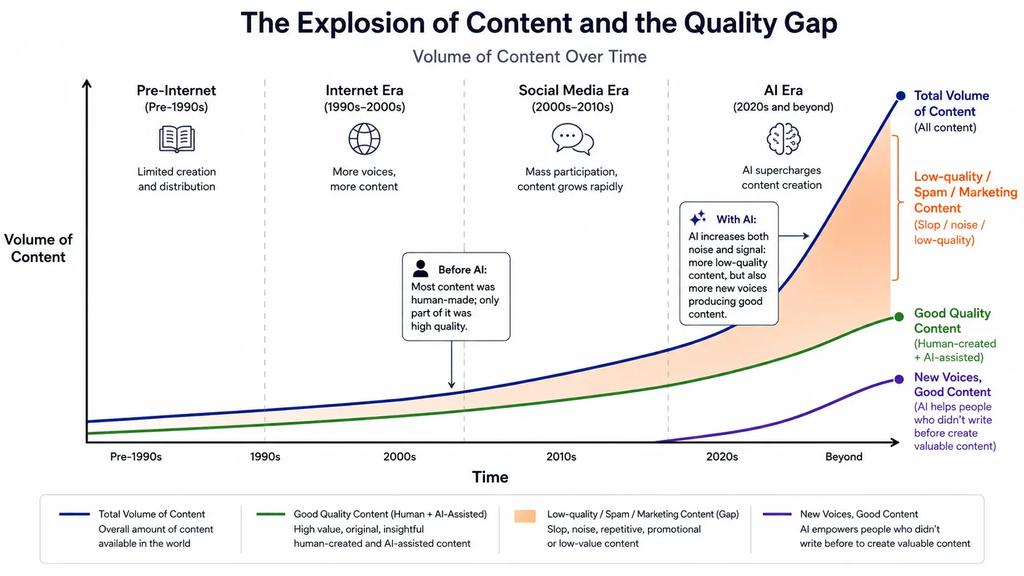 Volume of content over time, from the pre-internet era to the AI era. Total content has grown fastest; good-quality content has grown more slowly; the widening gap between them is low-quality, spam and marketing content; and a new line is starting to emerge — people who couldn't write before now producing valuable content with AI.
What AI can and can't do
AI is good at writing — give it an input and it'll produce something fluent and readable. What it doesn't do well is come up with new ideas on its own. It mostly works by combining things it's already seen in its training data. So if you ask AI to write about a topic without giving it any new input, what you get back is a rearranged version of what's already out there.
When someone who knows the area gives AI a specific input — something they noticed at work, a decision they made, a pattern across clients — the result is different. The thinking is theirs, and the model puts it into readable prose.
The question worth asking about content is whether the substance exists, and whether the writer would defend it if pushed. Whether AI touched the prose is a separate question, and should be a less interesting one.
EEEG
We've been using a four-letter test at re:cinq when we look at content. Each letter describes one thing strong content does:
- Educational — does the reader learn something they didn't know before? This is the substance.
- Entertaining — does the piece hold the reader's attention long enough for the point to come through? A piece that's useful but boring usually doesn't get finished.
- Emotional — does the piece make the reader feel something? Without that, the reader forgets it quickly.
- Grounded — can the reader trust what's being said? Is there evidence, experience, or credibility behind the claim?
We use this internally. Most strong writers do all four things without thinking about them, and naming them makes it easier to check a piece before publishing.
The first three were a good test for quality on their own for a long time. They've stopped working as well, because any model can now imitate the surface of Entertaining and Emotional — a good hook, a clean structure, a moment of emotional payoff — without any substance behind them. Grounded checks for evidence, experience, and credibility, which a model can't produce on its own.
What grounding looks like
A grounded piece has the writer's fingerprint on it. It names specific companies in specific years, sources its numbers in a way the reader can check, uses examples from places the writer has worked, and separates what the writer has done themselves from what they've read or inferred — admitting where they're uncertain.
A piece without grounding does none of that. Companies are made up, numbers float without sources, and the writing has no fingerprint because the writer hasn't put themselves in it. This kind of writing existed long before AI — what's changed is how cheap it's become to produce.
Without grounding, the other three Es can cause harm. A piece that's useful-sounding, well-paced, and emotionally engaging — but ungrounded — makes the reader feel they learned something they didn't. Boring content gets filtered out on its own, while well-written ungrounded content gets through.
Scoring
We score each dimension 1 to 5.
Educational. At 1, the reader leaves no smarter. At 3, they can describe a clear point in their own words an hour later. At 5, the piece changes how they think about a problem they're already working on.
Entertaining. At 1, the reader stops reading partway through. At 3, they finish without noticing the time. At 5, they send it to someone, reread it, or quote it in a meeting.
Emotional. At 1, the piece is flat. At 3, there's a clear tone but it doesn't take over. At 5, the writing connects to something the reader cares about beyond the topic itself.
Grounded. At 1, nothing is supported. The claims could be made up. At 3, the reasoning is plausible but unverifiable. At 5, the piece is specific, sourced, honest about its limits, and would survive a tough read by someone who knows the field.
Failure patterns
A few patterns come up often:
5/5/5/1 — integrity 1. The piece feels educational, reads well, has emotional weight, but the substance turns out to be made up or unsupportable. The reader walks away thinking they learned something they didn't.
1/5/5/1 — integrity 1. No substance, no evidence, but engaging and emotionally polished. Feels smart while reading; nothing left an hour later. This is the largest pile of AI-generated content right now. AI is very good at producing this kind of writing — good prose around a thin idea — and our feeds are full of it.
5/1/1/5. Substantive and well-grounded, but dry. The accurate paper most people don't finish. Honest, but doesn't reach far.
2 or 3 across the board. Not bad, but not useful either — the middle of every feed.
The goal is 4 or 5 on all four, which is hard. Substance and craft together are rare — most pieces have one or the other.
Integrity
Integrity is the question above the rubric: are the Entertaining and Emotional parts there to deliver the substance, or to make up for the lack of it?
When Grounded is low and Entertaining and Emotional are high, integrity is low by definition. The craft is doing manipulative work — making the reader feel something useful happened, when it didn't. 5/5/5/1 and 1/5/5/1 both score 1 on integrity. AI generates a lot of these right now, and most of what readers are skipping when they see "AI-written" is content with this shape.
For our editorial process, EEEG and integrity are most of the conversation before publishing. A low score on Educational, Entertaining, or Emotional usually means restructuring around a clearer point, opening, or frame. A low score on Grounded means the piece doesn't go out — publishing it would hurt trust in everything else we publish.
Most editorial processes check grammar, brand consistency, tone, and structure. AI passes all of those without trouble. They don't check whether there's something worth keeping. EEEG is one way to make that check more concrete.
Part 2 — Good Ideas Should Not Need Good Marketing to Survive — is coming soon.
If you're working through what AI does to how your engineering organisation produces and reviews work, From Cloud Native to AI Native is the long-form version of how we think about it. The book is now free — download it here.
Your next read

Good Ideas Should Not Need Good Marketing to Survive
Good ideas need a writer and an audience. AI moves one of those constraints. What that means for publishing, platforms, and engineering teams.
Pini Reznik6 mins read
Subscribe to Our Bi-Weekly AI Native Newsletter
Lessons from our client work, engineering deep-dives, and the AI Native research worth reading.
Bi-weekly. No spam, unsubscribe anytime.


 12mins